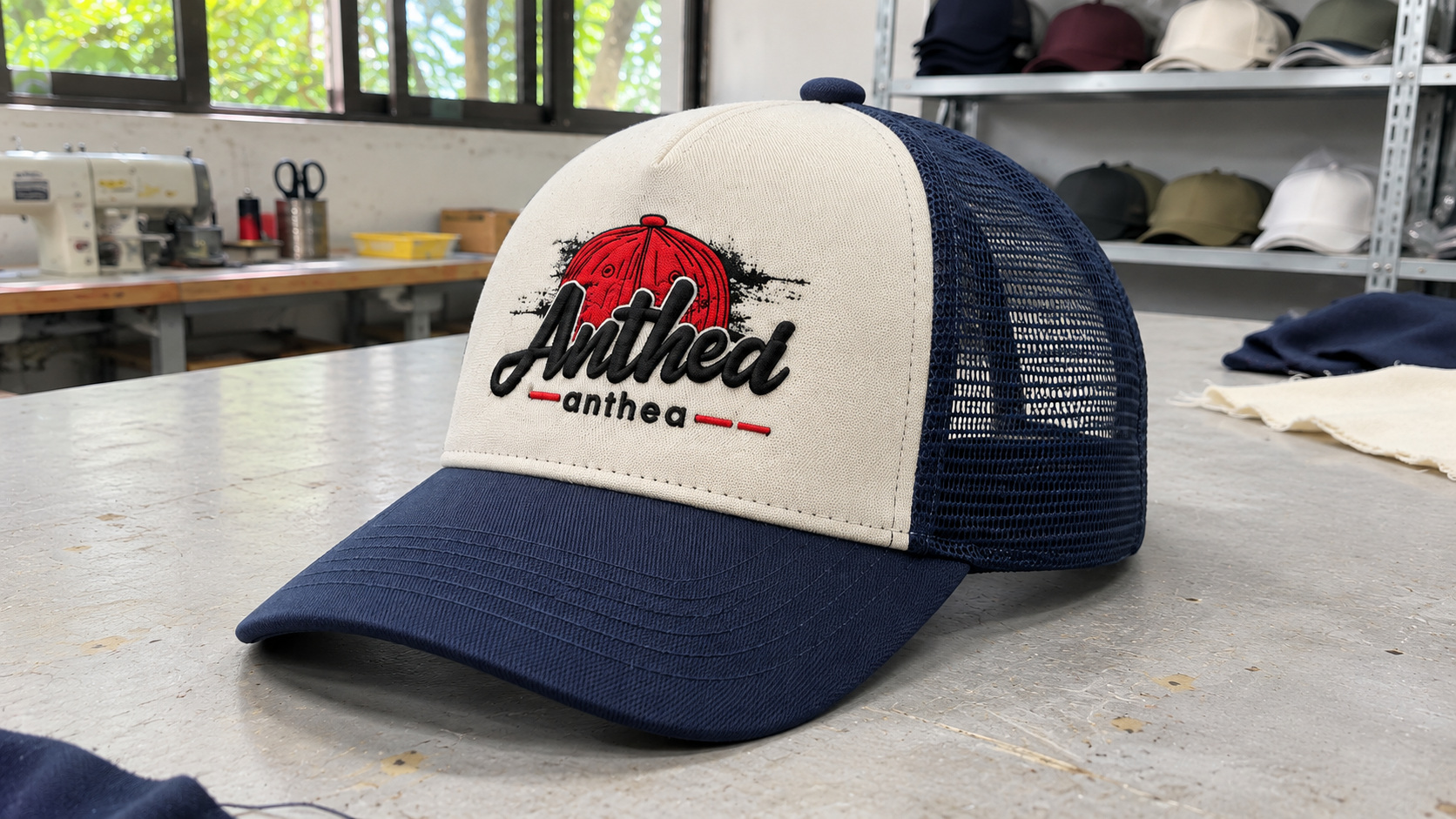
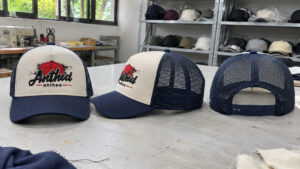
A trucker hat is a baseball-style cap with mesh panels at the back1 that allow air to flow through the crown. Classic trucker hats often have a foam front2, while many modern styles use a fabric front, such as cotton twill or a cotton-polyester blend. Most feature an adjustable snapback closure3, and the bill can be curved or flat4.
If you’re developing one for a brand, team, or event, start with two decisions: how you want the cap to sit on the head and how you want the logo to look. Those choices will help narrow down the crown profile, front-panel construction, and decoration method.
Trucker Hat vs. Baseball Cap vs. Snapback
These terms describe different features of a cap, so they can overlap.
| Term | What it describes | What to specify when ordering |
|---|---|---|
| Trucker hat | A baseball-style cap with mesh at the back | Front material, mesh color, crown profile, and bill shape |
| Baseball cap | The broader family of caps with a crown and a projecting bill | Whether you want a solid-fabric back or mesh panels |
| Snapback | A cap with an adjustable snap closure | The closure style and the head circumference range it needs to fit |
A cap with a mesh back and an adjustable plastic snap can be both a trucker and a snapback5. If you want a mesh back with a flat bill, specify both features in your request.
How to Choose a Trucker Hat for Your Brand
| Project | A starting configuration | What to check on the sample |
|---|---|---|
| Outdoor or event merchandise | Fabric front, curved bill, mesh back, adjustable snap | How the cap fits across your target head sizes and how the sweatband feels |
| Retro promotional cap | Foam front, curved bill, contrasting mesh | Whether the front holds its shape and the graphic looks even on the foam |
| Streetwear or retail collection | Structured fabric front with a mid- or high-profile crown | The side silhouette, available logo area, and whether the bill suits the collection |
| Everyday brand merchandise | Low-profile fabric front with a pre-curved bill | How close the crown sits to the head and whether the logo area is tall enough |
A low-profile trucker hat has a shallower crown, so it tends to sit closer to the head. Crown height and head circumference are separate measurements6. Ask your manufacturer how crown height is measured and what head circumference the closure can accommodate. If you already have a reference cap that fits well, send front and side photos or share a physical sample.
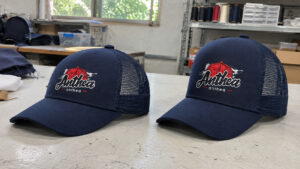
Foam and fabric fronts also feel different in hand. Foam gives the front a padded feel7 and a classic promotional look. A twill front can still hold a crisp shape when it has a structured backing8. Specify the front material and how firm you want the crown to feel.

Which Logo Method Works Best?
| Logo method | A good starting point for | What to check |
|---|---|---|
| Flat embroidery | Bold wordmarks and simple symbols | Letter spacing, edge definition, and how the stitching looks around a center seam |
| 3D puff embroidery | Thick lettering or a bold mark that needs raised detail | Whether narrow strokes and small gaps stay readable at the intended size |
| Woven or embroidered patch | A badge-style logo with a defined border | The patch dimensions, how the border follows the crown, and how the patch is attached |
| Printing | Graphics that rely on fine lines or multiple colors | Color, coverage, and finish on the actual front-panel material |
Many five-panel trucker designs have one uninterrupted front panel. A conventional six-panel design usually has a center seam.9 If small lettering or a narrow line would cross that seam, compare a seamless front, a different placement, and a patch before deciding. Review the artwork at its actual size on the physical cap.

What to Send for a Quote and Sample
Send your logo file, reference photos, estimated quantity by color, destination, and target delivery date. Include any requirements you already know for the crown profile, bill, front fabric, mesh, closure, labels, or packaging. A reference photo and a brief note about the fit are enough to start the conversation if you’re still developing the specifications.
When the sample arrives, check the fit, crown shape, logo size and placement, and the color match between the front fabric, mesh, and bill. Review the components together in daylight, particularly when they are meant to match. Record any changes in writing before approving bulk production.
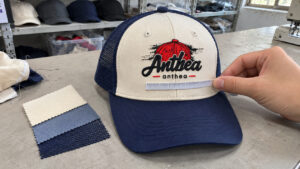
Anthea’s standard minimum order is 200 pieces per design. Sample production typically takes 7–10 business days after the design and specifications are confirmed. If your order includes several colorways, share the quantity for each so we can confirm the minimums and sample requirements for your project.
See Anthea’s trucker hat example or request a quote and sample.
-
"Trucker hat", https://en.wikipedia.org/wiki/Trucker_hat. An encyclopedic definition of the trucker hat identifies it as a baseball-cap style typically characterized by a mesh back, supporting the article’s distinction between trucker hats and solid-back baseball caps. Evidence role: definition; source type: encyclopedia. Supports: A trucker hat is commonly defined as a baseball-cap style with a mesh back.. ↩
-
"Trucker hat", https://en.wikipedia.org/wiki/Trucker_hat. A historical or encyclopedic account of the trucker cap describes the style as commonly using a foam front with a mesh back, supporting the article’s characterization of the classic form. Evidence role: historical_context; source type: encyclopedia. Supports: Foam fronts are historically associated with the classic trucker-cap style.. Scope note: The source would establish the historical association, not the proportion of all trucker hats that use foam fronts today. ↩
-
"Trucker hat", https://en.wikipedia.org/wiki/Trucker_hat. A neutral description of trucker caps notes their typical adjustable plastic snap closure, supporting the article’s statement that snapbacks are a common closure format for this cap type. Evidence role: general_support; source type: encyclopedia. Supports: Adjustable snap closures are commonly associated with trucker hats.. Scope note: This supports typical usage but may not quantify whether the closure appears on a numerical majority of current products. ↩
-
"Baseball cap", https://en.wikipedia.org/wiki/Baseball_cap. General references on baseball-cap construction describe the projecting bill or brim as a feature that can vary in shape, which contextualizes curved and flat bills as design options rather than separate cap categories. Evidence role: definition; source type: encyclopedia. Supports: Baseball-style caps may have different brim or bill shapes, including curved and flat versions.. Scope note: The support is for baseball-style caps broadly and may not isolate trucker hats as a separate sample. ↩
-
"Baseball cap", https://en.wikipedia.org/wiki/Baseball_cap. Definitions of trucker hats as mesh-back caps and snapbacks as caps with adjustable snap closures support the article’s point that the terms refer to different design attributes and can apply to the same cap. Evidence role: definition; source type: encyclopedia. Supports: “Trucker hat” and “snapback” describe different attributes that can coexist in the same cap.. ↩
-
"Determine Your Hat Size", https://my.alfred.edu/environmental-health-safety/determine-hat-size.cfm. Apparel measurement guidance distinguishes head circumference from vertical crown or headwear height measurements, supporting the article’s instruction to treat crown profile and size range as separate specifications. Evidence role: definition; source type: education. Supports: Head circumference and crown height are measured as different dimensions in headwear specification.. Scope note: The cited measurement guidance may address headwear or apparel measurement generally rather than trucker hats alone. ↩
-
"Evaluation of cushioning properties of plastic foams from compressive …", https://www.academia.edu/988136/Evaluation_of_cushioning_properties_of_plastic_foams_from_compressive_measurements. Materials-science literature describes polymer foams as compressible cellular materials with cushioning behavior, supporting the article’s explanation that a foam cap front feels padded compared with a woven fabric front. Evidence role: mechanism; source type: paper. Supports: Foam materials are compressible and cushioning, which explains their padded feel in a cap front panel.. Scope note: This support concerns foam materials generally and does not directly test hand-feel in trucker-hat panels. ↩
-
"Selecting Interfacings,Underlinings, and Linings – Publications", https://pubs.nmsu.edu/_c/C208.pdf?ref=workroom-wisdom-and-fabric-finds.ghost.io. Textile and apparel-construction sources describe backing or interfacing as a means of increasing fabric stiffness and shape retention, supporting the article’s statement that a twill cap front can hold a crisp form when structurally reinforced. Evidence role: mechanism; source type: research. Supports: Backing or interfacing can increase stiffness and help woven fabric panels retain shape.. Scope note: The evidence is contextual for reinforced woven fabrics and may not evaluate a specific cap model. ↩
-
"Five-Panel vs Six-Panel Caps: Buyer Comparison – Caps Island", https://capsisland.com/resources/guides/five-panel-vs-six-panel-caps. Headwear-construction references distinguish five-panel cap layouts from six-panel baseball-cap layouts and describe the center-front seam produced by two front panels in many six-panel designs, supporting the article’s construction comparison. Evidence role: general_support; source type: other. Supports: Five-panel and six-panel cap patterns differ in front-panel layout, with six-panel caps commonly forming a seam at the front center.. Scope note: Panel layouts vary by manufacturer, so the source would support the conventional pattern rather than every possible design. ↩