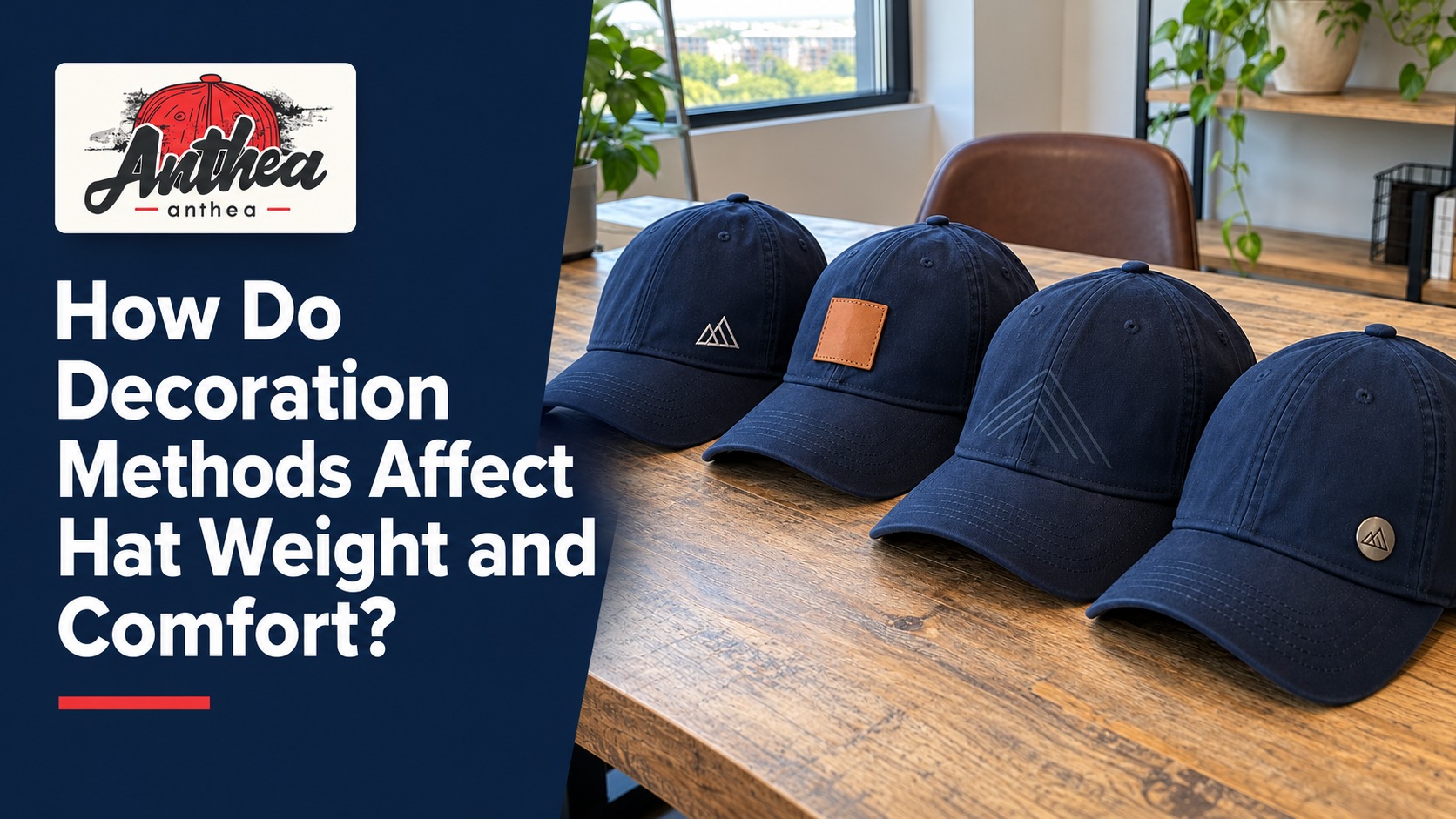
Decoration methods affect hat weight and comfort more than many buyers expect. A cap may look perfect in a product photo, but a heavy patch, dense embroidery, or metal accessory can make it feel hot, stiff, or front-heavy1. The solution is to choose decoration by real wearing use, not visual impact alone.
Decoration methods affect hat weight and comfort by changing where weight sits, how stiff the decorated area becomes, how much airflow the fabric keeps, and how the decoration feels against the wearer2. Embroidery, patches, printing, and metal details can all work well, but each one creates different comfort risks in bulk orders.
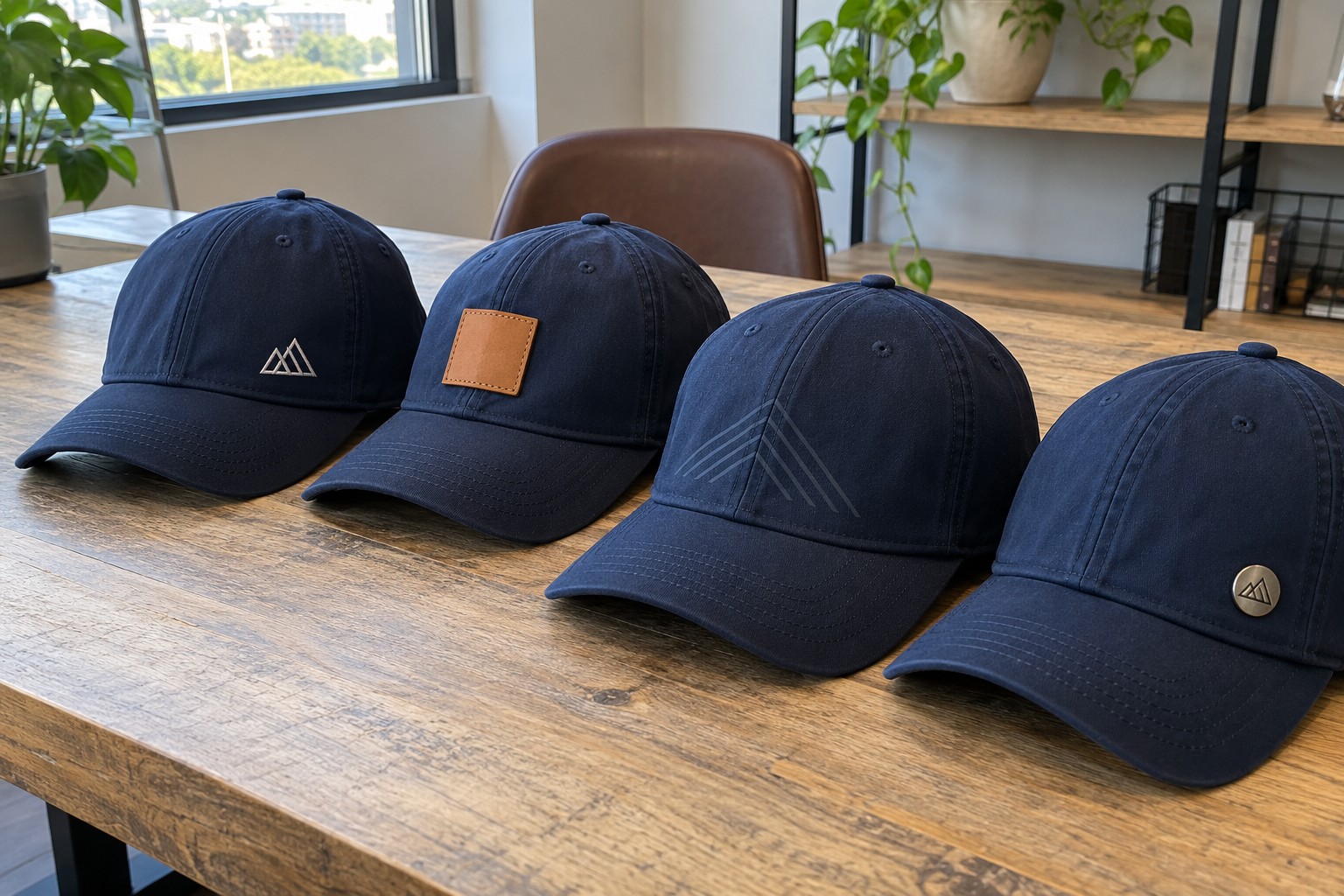
A good hat is not only a good-looking sample. It is a product people are willing to wear for hours. That is why I always suggest reviewing decoration with comfort in mind, especially for uniforms, events, promotions, team use, and resale programs.
How Do Decoration Methods Change Perceived Hat Weight?
A hat can feel uncomfortable even when its total weight is not high. Buyers often focus on grams, but wearers usually notice balance first3. A small decoration can feel heavier than expected if it is stiff, thick, or placed in the wrong position.
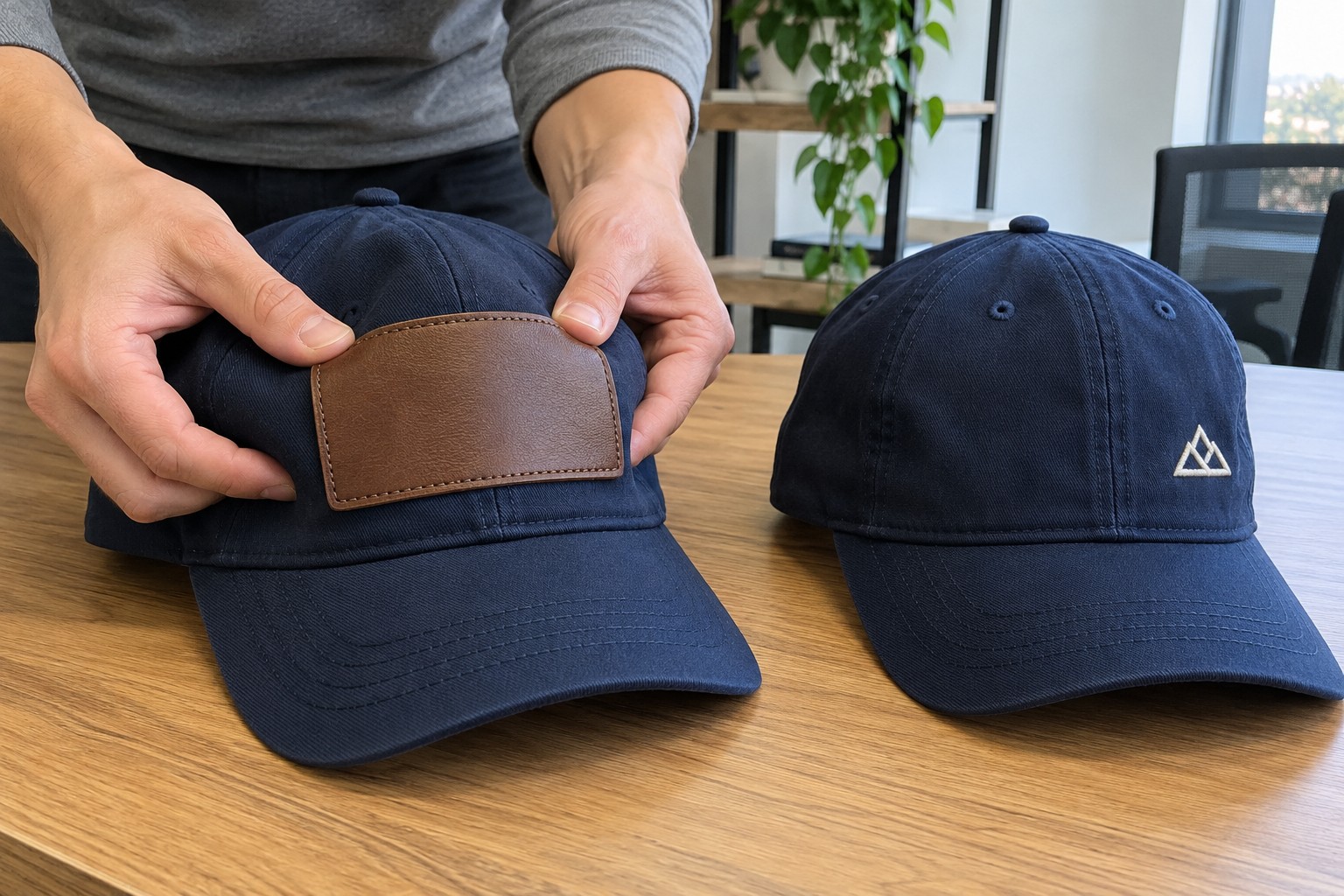
Decoration methods change perceived hat weight by adding weight, stiffness, and structure to specific areas of the cap. A front-heavy logo, thick patch, or dense embroidery can pull attention to the forehead area, while a lighter or better-distributed decoration can feel more natural during long wear.
Total Weight Is Only One Part of Comfort
When I review hat samples, I do not judge comfort by total weight alone. A hat that is slightly heavier overall can still feel better if the weight is spread evenly. A lighter hat can feel worse if the decoration creates a rigid block on the front panel.
This happens because the wearer feels the hat through contact points, not through a scale4. The key areas are:
- Forehead contact area
- Crown structure
- Side panels
- Back closure
- Top button and seams
- Front logo position
If a decoration sits on the front panel, the wearer may feel it indirectly through pressure, stiffness, or heat. This is especially true for structured caps, trucker caps, and promotional hats worn outdoors.
Why Front-Heavy Decoration Feels Different
Many popular logo positions are on the front crown. This placement is visually strong, but it can also create a front-heavy feel. The issue is not always the actual mass. It can also be the way the decoration changes the movement of the fabric.
For example:
| Decoration Choice | Possible Comfort Effect | Buyer Note |
|---|---|---|
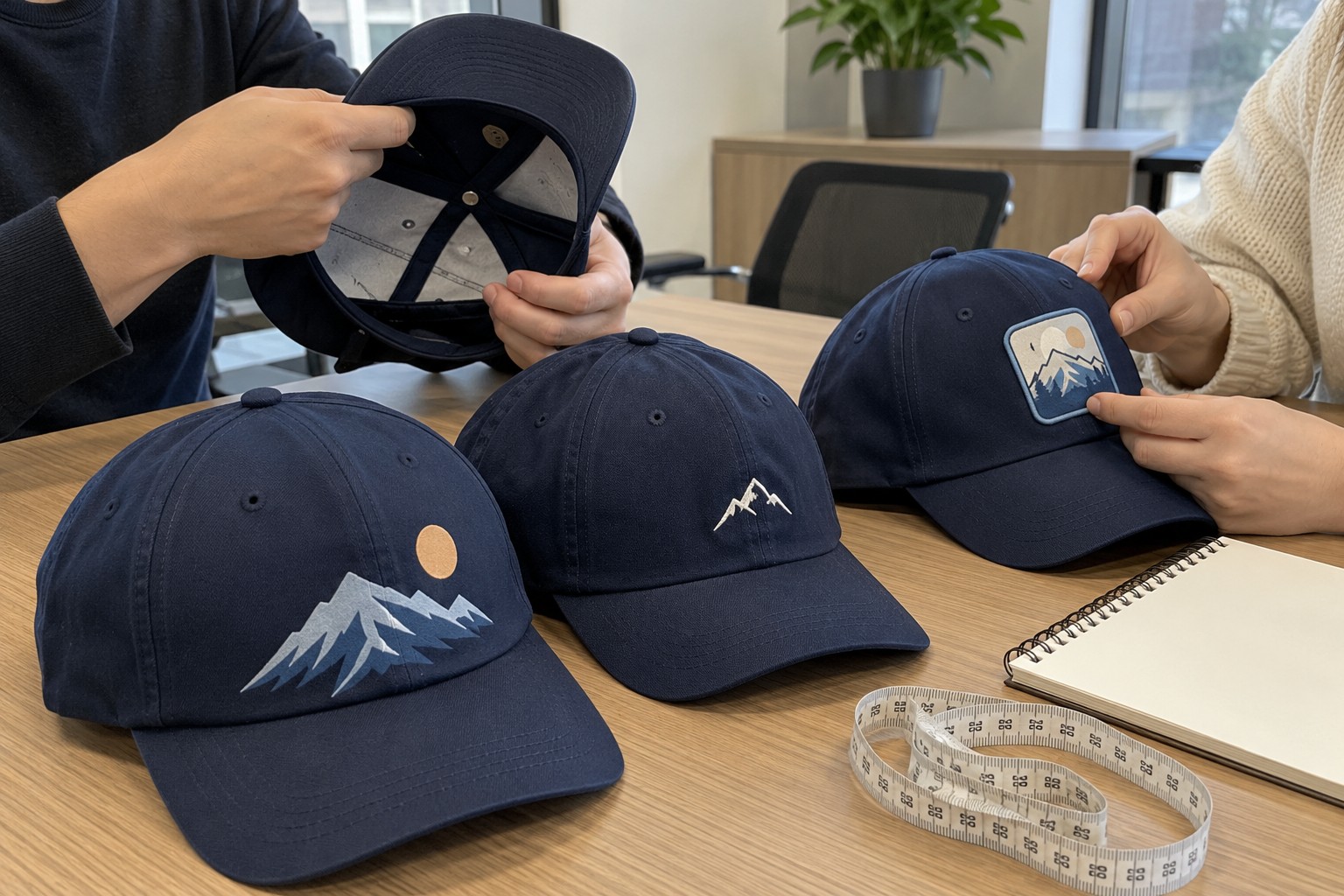
| Dense flat embroidery | Adds thread density and firmness | Good for classic logos, but check stiffness |
| 3D embroidery | Adds raised thickness | Strong visual effect, but may feel rigid |
| Leather patch | Adds local weight and thickness | Premium look, but can trap heat |
| Rubber patch | Flexible or firm depending on material | Check bend and edge feel |
| Screen print | Usually light | Check durability for washing and abrasion |
| Metal badge | Concentrated weight | Check scratch risk and attachment method |
A buyer may see a thick logo and think it looks more premium. However, the wearer may feel the hat is less comfortable after one hour. This is a common gap between sample appearance and real usage.
Sample Photos Can Be Misleading
Photos highlight shape, color, and branding. They do not show pressure, heat, or stiffness well.5 A raised logo may look excellent on a front-facing sample photo, but the same logo may feel too rigid during long use.
I have seen buyers become excited about a thick decoration during photo review, then become more cautious after touching the sample. This is normal. A hat is a wearable product, so the hand feel and fit test matter.
Before approving a bulk order, I suggest buyers ask:
- Does the decorated area bend naturally?
- Does the hat feel balanced when worn?
- Does the logo area press against the forehead?
- Does the decoration create extra heat?
- Will the target wearer keep using the hat after the event?
These questions are simple, but they prevent many bulk order problems. For B2B buyers, comfort is not a small detail. If employees, customers, or event participants stop wearing the hat, brand exposure drops and the order budget loses value.
Which Decoration Methods Feel Lightest or Heaviest in Real Wear?
Buyers often ask which decoration option is the lightest. The better question is which option fits the wearing scenario. Printing is often lighter, while embroidery, patches, and metal pieces may add more local structure.6 But no method is always best.
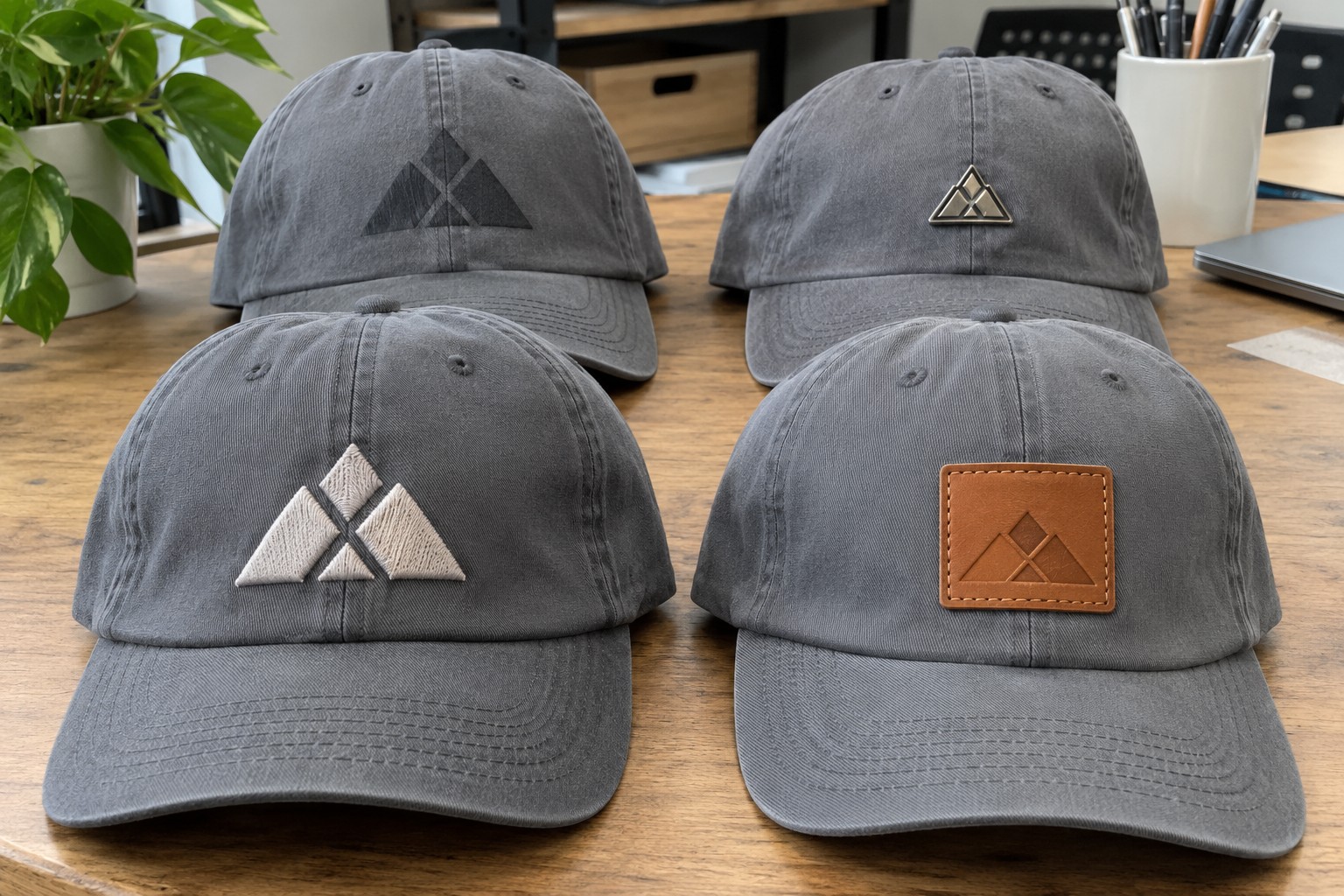
Decoration methods feel light or heavy depending on material, size, placement, and stiffness. Printing usually adds less bulk, embroidery adds thread density, patches add local thickness, and metal decorations can concentrate weight. The most comfortable choice depends on how long the hat will be worn and where the decoration sits.
Embroidery: Classic, Durable, but Sometimes Stiff
Embroidery is one of the most common decoration methods for caps. It gives a clean, traditional look, and many buyers associate embroidery with quality. It also works well for logos, names, teams, and corporate designs.
However, embroidery adds thread to the fabric. More stitches usually mean more density.7 A small, simple logo may feel soft and natural. A large, tightly filled logo can make the front panel firmer.
Common embroidery comfort factors include:
- Stitch density
- Logo size
- Thread coverage
- Backing material
- Placement
- Hat fabric thickness
- Structured or unstructured crown style
3D embroidery adds even more height.8 It can look premium and bold, especially on sports caps and streetwear styles. But it may also create more stiffness. For short-term promotional wear, that may be acceptable. For all-day staff use, it should be tested carefully.
Patches: Premium Look with Local Thickness
Patches are popular because they create a strong branded look. A patch can be made from woven fabric, leather, faux leather, rubber, PVC, felt, or other materials. Each material affects weight and comfort differently.
A woven patch may feel lighter and more flexible. A leather patch may look premium but may also hold heat. A rubber patch may feel modern and durable, but its comfort depends on thickness and edge softness.
| Patch Type | Visual Effect | Comfort Consideration |
|---|---|---|
| Woven patch | Detailed and flat | Usually flexible, but edges matter |
| Leather patch | Premium and classic | Can feel warm or stiff |
| Rubber/PVC patch | Modern and bold | Check thickness and flexibility |
| Felt patch | Soft visual texture | May absorb dust or moisture |
| Printed patch | Lightweight look | Durability depends on print quality |
Patches also create an extra layer over the hat fabric. That layer can reduce breathability in that area.9 On a winter cap, this may not matter. On a summer event cap, it may matter a lot.
Printing: Light, Flexible, but Not Always the Most Durable
Printing is often chosen when buyers want a lighter decoration. It can keep the fabric more flexible, especially when the print is thin and well applied. Printing also works well for large designs that would become too stiff with embroidery.
However, printing has trade-offs. Some print methods may crack, fade, or wear faster depending on fabric type, washing behavior, sun exposure, and friction.10 For a one-day event, this may be acceptable. For retail or staff uniforms, buyers should review durability more carefully.
Printing works especially well when:
- The design has gradients or fine details
- The buyer wants lower local thickness
- The hat should remain soft and flexible
- The use case is promotional or seasonal
- The logo area is large
Metal Decorations: Small Size, Strong Impact, Higher Risk
Metal accessories can look premium. They may include badges, plates, rivets, charms, buckles, or small logo details. The issue is that metal concentrates weight11. A small piece may not add many grams, but it can feel noticeable because the weight is focused in one spot.
Metal also creates contact risks. Edges, attachment backs, and surface temperature can affect comfort. If a metal part is poorly positioned or poorly finished, it may scratch, press, or become annoying during wear.
For B2B buyers, I suggest checking metal details carefully during sample review. The buyer should inspect:
- Edge smoothness
- Attachment security
- Backside contact feel
- Rust resistance claims or finish documents
- Placement away from pressure points
- Behavior during packing and transport
Metal can be a good option for premium programs, but it should be chosen with care. It is not automatically better because it looks expensive.
How Do Decoration Methods Affect Breathability and Stiffness?
A hat can feel too hot or rigid even when the fabric itself is breathable.12 Decoration can block airflow, add layers, or reduce the natural movement of the crown. This matters most for outdoor work, sports events, school activities, and long promotional use.
Decoration methods affect breathability and stiffness by covering fabric pores, adding backing, increasing material layers, or making the decorated panel less flexible. Large embroidery, heavy patches, and thick heat transfers can reduce comfort, while lighter designs may preserve more airflow and natural fabric movement.
Breathability Is Local, Not Just Overall
Many buyers ask whether a hat is breathable. That question is useful, but it is not complete. A hat may have mesh back panels, cotton twill, or lightweight fabric, but decoration can still make the front area feel warm.
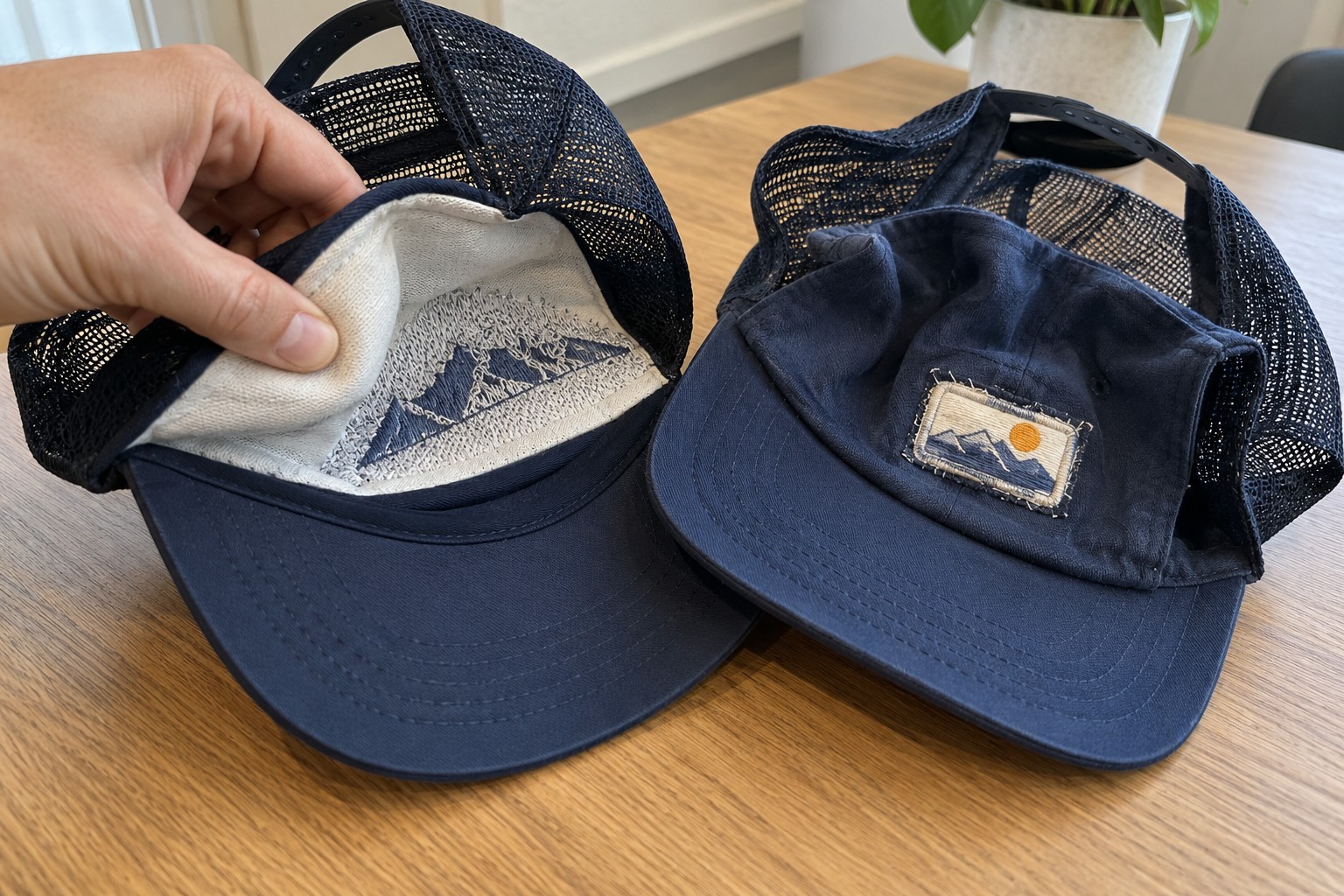
This happens because breathability is local. If the decoration covers a large area, that section may trap more heat. A leather patch on a front panel, for example, may block airflow exactly where the forehead releases heat. A dense embroidered design may also reduce flexibility and airflow in that specific zone.
The issue becomes more obvious in warm markets, outdoor events, and long wearing situations. A hat used for a two-hour product launch has different comfort needs from a hat worn by staff every day in hot weather.
Stiffness Changes Fit
Stiffness affects how the hat sits on the head. A soft front panel can shape naturally. A stiff decorated panel may hold its shape but may also resist the wearer’s head shape.
This is not always bad. Some buyers want a structured look. A firm logo area can make the hat look clean and retail-ready. However, comfort can drop if stiffness becomes excessive.
Here is a practical way to think about it:
| Wearing Scenario | Decoration Priority | Comfort Risk to Check |
|---|---|---|
| Short event giveaway | Visual impact and cost | Basic fit and no sharp edges |
| Staff uniform | Long-wear comfort | Heat, pressure, durability |
| Outdoor promotion | Breathability | Large blocked logo areas |
| Retail merchandise | Appearance and perceived quality | Balance between premium feel and wearability |
| Sports/team use | Movement and sweat comfort | Stiff panels and heavy front logos |
The Backing Material Matters
Embroidery and patches often use backing or attachment materials. Buyers may not see these clearly in photos, but wearers may feel the results. Backing can add firmness, thickness, and sometimes a scratchy feel if it is not properly finished.
During sample review, I like to turn the hat inside and check the decoration area from the back. This simple step often reveals whether the inside finish is clean. It also helps buyers identify possible friction points.
A buyer should check:
- Whether the inside surface feels rough
- Whether threads are trimmed cleanly
- Whether backing corners are hard
- Whether patch stitching creates pressure
- Whether heat-transfer edges are smooth
- Whether the logo area bends with the hat
These checks do not require a laboratory. They are practical sample review habits. They help buyers make better decisions before committing to hundreds or thousands of pieces.
Bigger Is Not Always Better
A larger decoration may improve brand visibility. It may also reduce comfort if it covers too much of the crown. This is where the buyer needs to balance branding and wearability.
For example, a large front logo may be great for photos. But if the hat feels hot, employees may leave it in a locker. A smaller logo, side embroidery, or lighter print may create better real exposure because people actually wear the product.
This is an important B2B point. The goal is not only to produce a beautiful hat. The goal is to produce a hat that supports the campaign, team identity, or brand message over time.
A decoration choice that reduces wearing time also reduces branding value.
That is why comfort should be part of the design brief from the beginning. It should not be a last-minute issue after the sample arrives.
How Should B2B Buyers Choose Decoration Methods Before Bulk Ordering?
Bulk hat orders carry more risk than a single sample because small comfort issues multiply. If the decoration feels too heavy, hot, or stiff, many recipients may stop wearing the hat. Buyers need a structured review process before approval.
B2B buyers should choose decoration methods by matching the design to the wearing scenario, target user, climate, order purpose, and sample feedback. They should review weight balance, stiffness, breathability, contact feel, durability, and cost before confirming bulk production.
Start with the Wearing Scenario
The best decoration choice depends on how the hat will be used. A hat for a VIP gift box is different from a hat for construction-site staff, a school sports day, or a trade show giveaway.
Before choosing decoration, I suggest buyers define:
-
Who will wear the hat?
Staff, customers, athletes, students, visitors, or retail buyers. -
How long will they wear it?
One hour, one day, several weeks, or daily. -
Where will they wear it?
Indoor event, hot outdoor market, warehouse, beach, sports field, or streetwear setting. -
What matters most?
Brand visibility, premium feel, low cost, comfort, durability, or resale value. -
What is the climate?
Hot and humid markets need more attention to breathability and heat.
When these answers are clear, the decoration decision becomes easier. The buyer can avoid choosing a heavy premium detail for a hot outdoor event or a fragile print for long-term workwear.
Use a Sample Review Checklist
A sample is not only for checking logo accuracy. It is also for checking wearability. I have seen buyers approve color and logo size quickly, then discover later that the hat was not comfortable enough for actual use. A simple checklist helps avoid that.
| Review Item | What to Check | Why It Matters |
|---|---|---|
| Logo position | Front, side, back, brim | Position changes balance and visibility |
| Decoration thickness | Raised or flat | Thickness affects stiffness and packing |
| Inside finish | Threads, backing, edges | Rough areas may irritate skin |
| Flexibility | Bend the decorated panel | Stiff panels may reduce comfort |
| Breathability | Covered area size | Large coverage can feel hotter |
| Weight balance | Wear for several minutes | Front-heavy designs are easier to notice |
| Durability expectation | Use case and care | Printing and patches vary by use |
A short wear test is useful. The buyer should put on the sample, adjust it, move around, and wear it long enough to notice pressure. This is not a scientific lab test. It is a practical buyer review.
Balance Premium Appearance with Usage Rate
Many buyers want the hat to look premium. That is understandable. A high-quality decoration can improve perceived value. But “premium” should not mean “thick,” “heavy,” or “rigid” by default.
A comfortable hat with a clean logo may create more brand exposure than a dramatic hat that people avoid wearing. This is especially true for:
- Employee uniforms
- Long conferences
- Outdoor festivals
- School events
- Sports teams
- Tourism promotions
- Community campaigns
If the campaign goal is visibility, wearing rate matters. The most beautiful hat does not help if it stays in a bag.
Ask Suppliers the Right Questions
Buyers should ask practical questions before bulk approval. Good suppliers should be able to explain decoration options, sample limitations, and production trade-offs. They should also be willing to recommend changes if a design may create comfort issues.
Useful supplier questions include:
- Can this logo be made lighter without losing the main visual effect?
- Will this decoration make the front panel stiff?
- Is the patch material flexible or firm?
- Can the logo be moved slightly to improve balance?
- Is there backing on the inside?
- Can I review a physical sample before bulk production?
- What are the durability limits of this print method?
- Will packing pressure affect raised decorations?
- Can the decoration be customized for different budget levels?
These questions keep the discussion practical. They also help buyers avoid choosing decoration based only on photos.
Consider Cost, But Do Not Ignore Comfort
Cost matters in B2B buying. Large orders need budget control. However, the cheapest option is not always the best value if it reduces use. The most expensive option is not always the best value either if it makes the hat uncomfortable.
A better decision looks at total value:
Total value = visual quality + comfort + durability + usage rate + cost fit
This is why I recommend comparing two or three decoration options during sampling when the order is important. For example, a buyer may compare flat embroidery, woven patch, and print for the same logo. The best option may become clear only after touching and wearing the samples.
For bulk orders, one small decision can affect thousands of user experiences. That is why decoration methods should be part of procurement evaluation, not only graphic design.
Frequently Asked Questions
Does embroidery make a hat heavier?
Embroidery can make a hat feel heavier or stiffer, especially when the logo is large, dense, or raised. The actual weight increase may be small, but the wearer may notice the added firmness on the front panel. Buyers should check stitch density, backing, and placement during sample review.
Are printed logos more comfortable than patches?
Printed logos are often lighter and more flexible than patches, but they are not always the best choice. Print comfort depends on ink type, fabric, coverage area, and durability needs. Patches may feel more premium, while printing may suit lightweight promotional hats better.
Do metal decorations make hats uncomfortable?
Metal decorations can be comfortable when they are small, smooth, secure, and well placed. However, they can concentrate weight or create scratch risks if the edges or backing are poor. Buyers should inspect metal details carefully before approving bulk production.
Is 3D embroidery good for long-wear hats?
3D embroidery gives a bold, premium look, but it can add stiffness and raised thickness. It may work well for fashion or short-term wear. For long-wear uniforms, outdoor events, or hot climates, buyers should test comfort before placing a large order.
What is the best decoration method for custom hats?
There is no single best decoration method for every custom hat. The right choice depends on logo design, budget, climate, wearing time, fabric, and target user. Buyers should compare visual effect, weight balance, breathability, stiffness, and durability before confirming production.
Conclusion
Decoration methods affect hat weight and comfort through more than total grams. They change balance, stiffness, airflow, contact feel, and long-term wearability. Embroidery, patches, printing, and metal details can all be good choices when they match the real use case. Before bulk ordering, I recommend reviewing physical samples, checking the inside finish, and testing how the hat feels during actual wear. If you are planning a custom hat order, use decoration as both a branding decision and a comfort decision before final approval.
-
"Comfort Evaluation of Wearable Functional Textiles – PMC – NIH", https://pmc.ncbi.nlm.nih.gov/articles/PMC8585350/. Textile comfort research shows that perceived clothing comfort depends on mechanical stiffness, thermal-moisture transfer, and skin contact conditions; the evidence is contextual because most studies examine garments or textile assemblies rather than decorated caps specifically. Evidence role: mechanism; source type: paper. Supports: Textile comfort is influenced by mechanical properties, thermal-moisture behavior, and localized contact conditions.. Scope note: Contextual support from textile and clothing comfort studies, not direct proof for each hat decoration type. ↩
-
"Design considerations for low-level risk personal protective …", https://pmc.ncbi.nlm.nih.gov/articles/PMC6546585/. Research on sensorial and thermo-physiological clothing comfort identifies fabric stiffness, air permeability, moisture/heat transfer, and skin-contact properties as contributors to perceived comfort; the link to cap decoration is inferential because the cited literature generally addresses textile systems rather than specific hat embellishments. Evidence role: mechanism; source type: paper. Supports: Apparel comfort is a multidimensional response involving mechanical, thermal, moisture, and tactile properties.. Scope note: The source would support the comfort mechanisms generally, not quantify the effect of each decoration method on caps. ↩
-
"A Novel Helmet Fitness Evaluation Device Based on … – PMC", https://pmc.ncbi.nlm.nih.gov/articles/PMC6767239/. Ergonomic studies of worn equipment indicate that comfort and perceived load are influenced by mass distribution and localized loading as well as total weight; the evidence is contextual because most available studies concern helmets or wearable equipment rather than casual caps. Evidence role: general_support; source type: paper. Supports: Human perception of worn objects is affected by distribution of mass and localized loading, not only total mass.. Scope note: Likely indirect evidence from helmets or wearables, not a cap-specific wearer survey. ↩
-
"Assistive Relief Tool for Early Childhood and Special … – PMC", https://pmc.ncbi.nlm.nih.gov/articles/PMC9146773/. Studies of apparel and head-worn equipment comfort show that localized pressure distribution and contact points are associated with discomfort ratings; the application to decorated caps is contextual because pressure data are usually collected for fitted garments, helmets, or protective equipment. Evidence role: mechanism; source type: paper. Supports: Localized pressure and contact distribution affect perceived comfort in worn products.. Scope note: Supports the mechanism of localized contact discomfort, not a measured threshold for caps. ↩
-
"Seeing as Feeling? The Impact of Tactile Compensation …", https://pmc.ncbi.nlm.nih.gov/articles/PMC10813092/. Consumer and haptics research finds that visual product information cannot fully substitute for tactile assessment of properties such as texture, stiffness, and material feel; this is contextual support because the studies typically address online shopping or consumer goods broadly rather than custom hats specifically. Evidence role: general_support; source type: paper. Supports: Visual product information alone does not fully convey tactile and haptic properties relevant to comfort.. Scope note: Contextual evidence about visual versus tactile product assessment. ↩
-
"influence of embroidery stitches on the properties of textile …", https://www.academia.edu/30987620/INFLUENCE_OF_EMBROIDERY_STITCHES_ON_THE_PROPERTIES_OF_TEXTILE_FABRICS. Textile production references describe printing as a surface coloration process and embroidery or appliqué as methods that add thread or additional material layers, supporting the general distinction in added bulk; the source would not by itself determine comfort for a particular cap design. Evidence role: general_support; source type: education. Supports: Different textile decoration methods add different amounts of material, thickness, and structure to a fabric surface.. Scope note: General manufacturing support, not a universal ranking for every ink, patch, or embroidery specification. ↩
-
"influence of embroidery stitches on the properties of textile …", https://www.academia.edu/30987620/INFLUENCE_OF_EMBROIDERY_STITCHES_ON_THE_PROPERTIES_OF_TEXTILE_FABRICS. Textile and embroidery references define stitch density by the concentration of stitches in a given area, supporting the statement that increasing stitches over the same design area increases density; the definition does not alone establish how much stiffness a specific cap logo will have. Evidence role: definition; source type: education. Supports: Embroidery density is commonly defined in relation to the number of stitches within a given area or spacing between stitches.. Scope note: Supports the terminology and construction principle, not the comfort outcome. ↩
-
"3D Puff Embroidery 101: Everything You Need to Know", https://prodigitizing.com/3d-puff-embroidery-101/. Embroidery technique references describe 3D or puff embroidery as a raised method commonly produced by stitching over foam or another dimensional substrate, supporting the claim that it adds height; the source does not prove that all 3D embroidery is uncomfortable. Evidence role: definition; source type: education. Supports: 3D or puff embroidery creates raised designs by adding dimensional material under the stitches.. Scope note: Defines the decoration method but does not measure wearer comfort. ↩
-
"INFLUENCE OF MULTILAYER INTERLOCKED FABRICS …", https://upcommons.upc.edu/bitstreams/9f3e10f4-a709-4de2-870e-2b4e1de1f78d/download. Textile air-permeability studies show that fabric structure and additional layers affect the rate of air passage through a textile assembly, supporting the mechanism by which a patch may reduce local breathability; the evidence is contextual because patch materials and attachment methods vary widely. Evidence role: mechanism; source type: paper. Supports: Additional fabric or material layers can reduce air permeability compared with an uncovered textile area.. Scope note: Supports the airflow mechanism generally, not the exact breathability loss for a specific patch. ↩
-
"Reduction of ultraviolet transmission through cotton T-shirt …", https://pubmed.ncbi.nlm.nih.gov/11312422/. Textile testing standards for colorfastness to washing, rubbing, abrasion, and light exposure support the claim that printed decoration durability depends on substrate and use conditions; the standards establish relevant test categories rather than predicting the lifespan of a particular print. Evidence role: general_support; source type: institution. Supports: Textile print performance is commonly evaluated with laundering, rubbing/abrasion, and lightfastness tests.. Scope note: Supports the relevant durability factors, not a specific failure rate. ↩
-
"Wearable Sensors in Industrial Ergonomics: Enhancing Safety …", https://pmc.ncbi.nlm.nih.gov/articles/PMC11902643/. Reference data on material density show that common metals are generally much denser than textile fibers and many polymers, supporting the physical basis for localized mass from metal accessories; the comfort effect remains contextual because it depends on component size, placement, and attachment. Evidence role: mechanism; source type: encyclopedia. Supports: Metals generally have higher density than textile and polymer materials, so small metal components can add localized mass.. Scope note: Material-density support only; it does not directly measure discomfort from metal cap accessories. ↩
-
"Thermo-Physiological Comfort Properties of Sportswear with …", https://pmc.ncbi.nlm.nih.gov/articles/PMC8624076/. Textile comfort research indicates that air permeability, heat and moisture transfer, and mechanical stiffness jointly influence perceived comfort, supporting the claim that a breathable fabric can still feel hot or rigid when modified by added materials; the evidence is contextual rather than cap-specific. Evidence role: mechanism; source type: paper. Supports: Thermal comfort and tactile comfort depend on air permeability, heat and moisture transfer, and fabric mechanical properties, not fabric breathability alone.. Scope note: General textile comfort evidence, not direct testing of decorated hats. ↩