You receive a perfect sample, but you feel nervous about ordering 500 pieces because a bad batch could ruin your brand’s reputation and cost you thousands of dollars.
To ensure consistency, you must insist on a Pre-Production Sample (PPS)1 made from actual bulk materials2, create a detailed Tech Pack3, and establish clear tolerance levels4 with your factory before mass production begins.
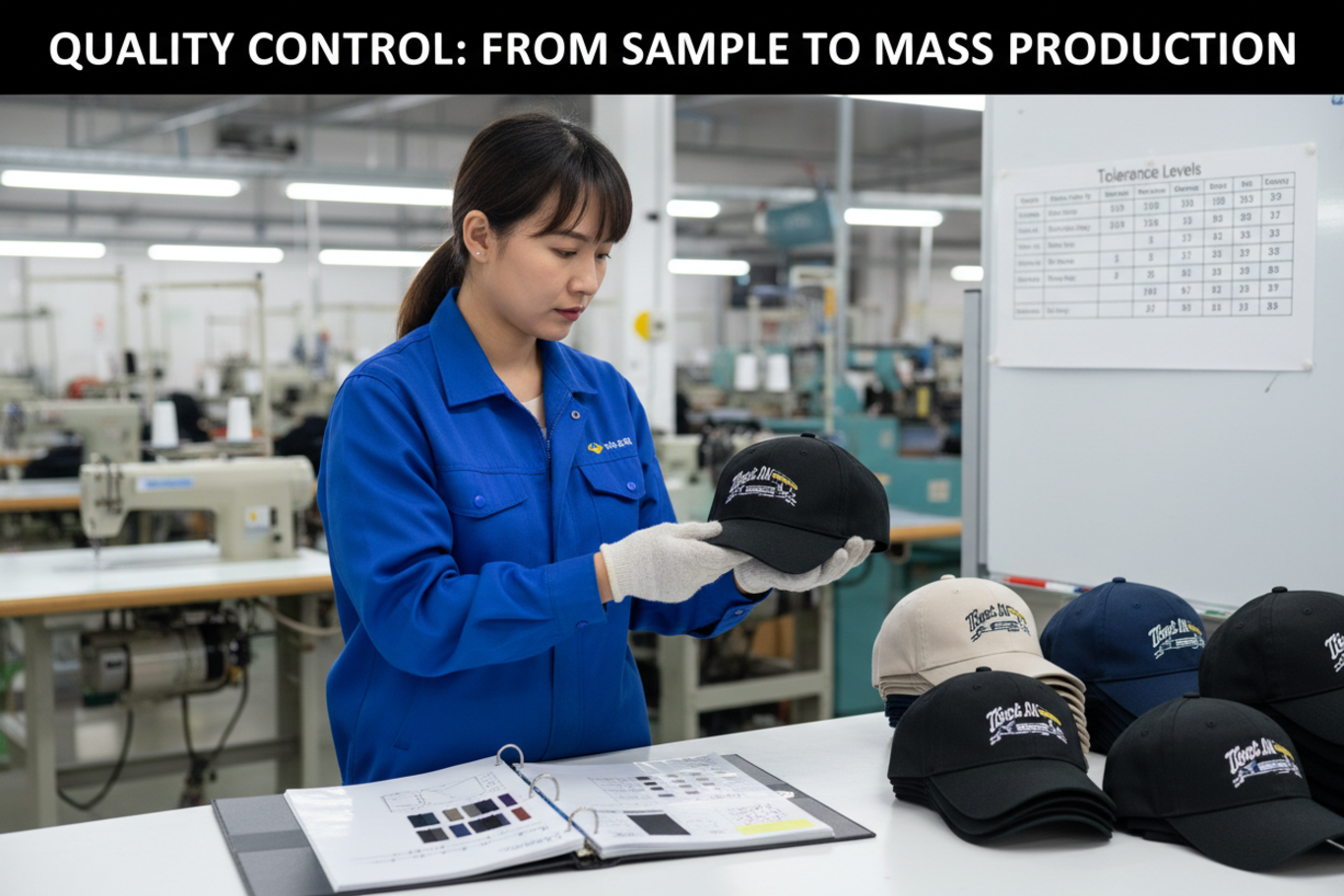
Many brand owners face a common nightmare. You spend weeks perfecting a design. The sample arrives, and it looks amazing. The embroidery is crisp, and the shape is perfect. Then, you pay the deposit for the bulk order. Six weeks later, the boxes arrive. You open them, and your heart sinks. The colors look slightly off, or the fit feels different. This happens often in manufacturing, but it is not bad luck. It is usually a failure in the process. At Anthea, I have seen many clients worry about this. I want to explain exactly how we bridge the gap between a single perfect sample and thousands of consistent hats.
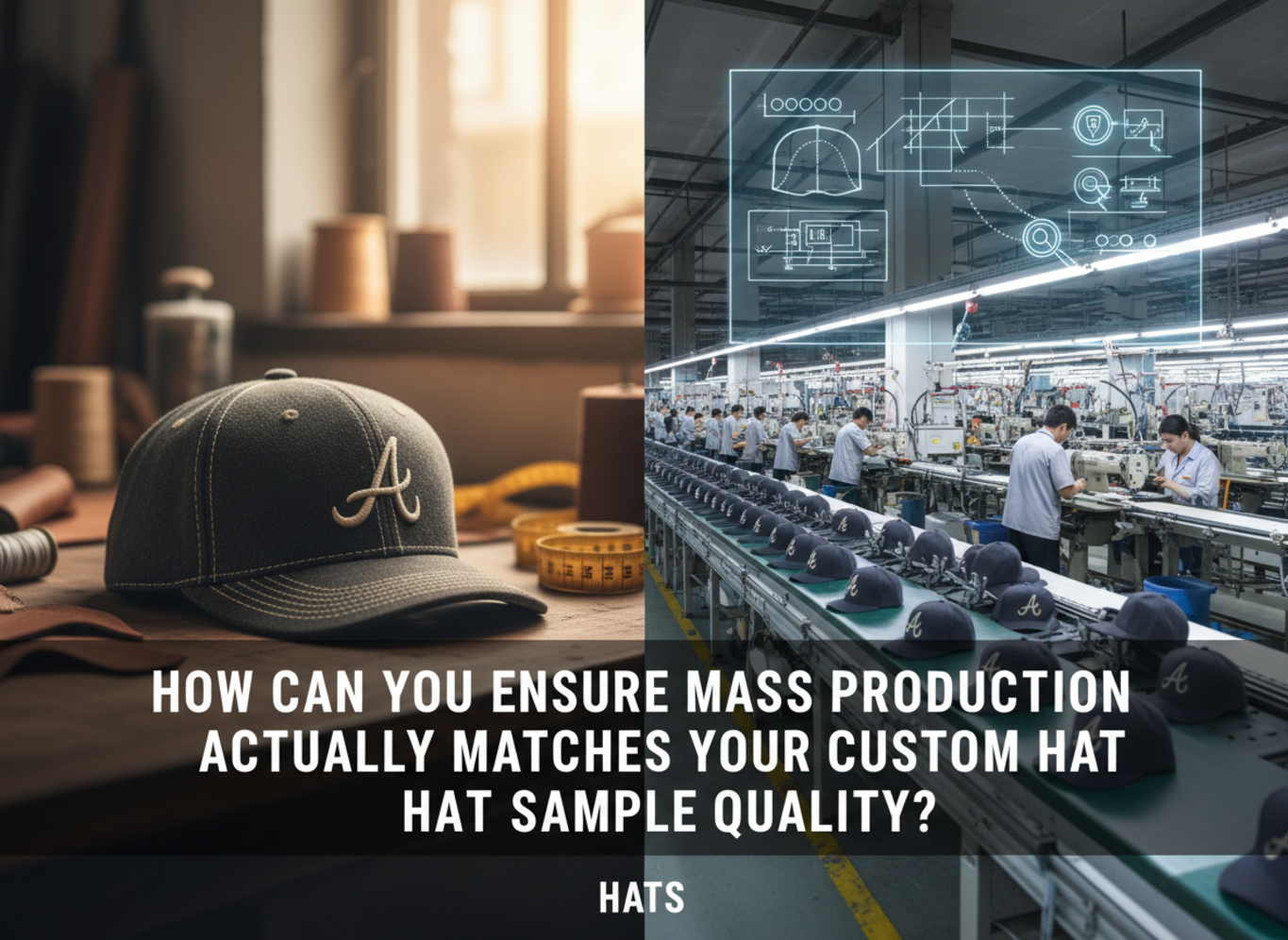
How do you ensure sample quality matches bulk production?
It is the biggest fear for any brand owner to receive a bulk order that looks nothing like the prototype they approved.
We use the "Golden Sample" method5 where the final approved sample becomes the absolute standard for every worker on the production line6 to follow strictly.
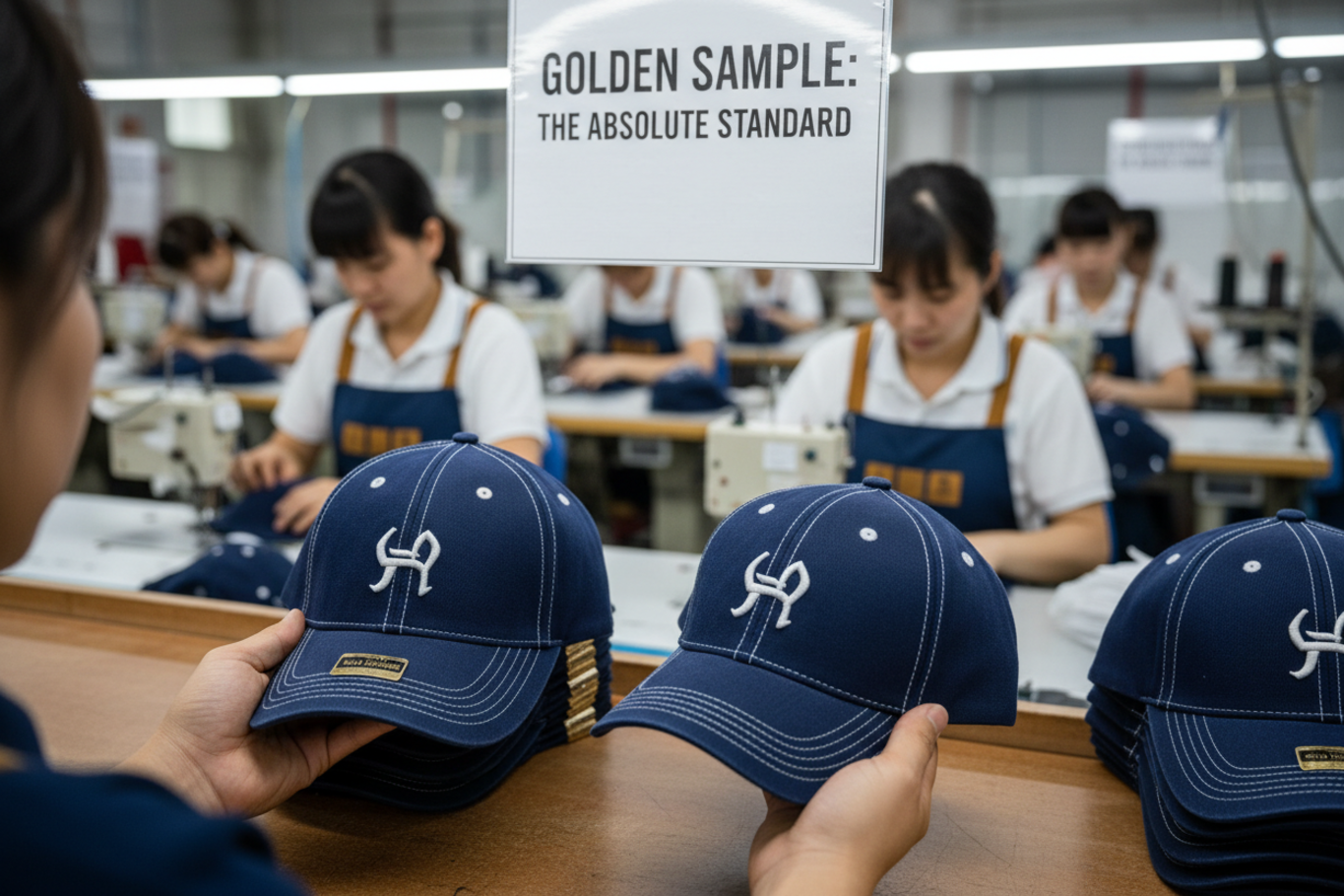
The "Golden Sample" is the most important tool in our factory. When you approve a sample, I do not just put it in a box. I tag it as the "Master" or "Golden" sample7. This hat hangs right on the production line6. Every time a worker sews a brim or attaches a sweatband, they can look at that Golden Sample. It acts as the physical rulebook for your order. If a worker is unsure about the stitching width8, they measure the Golden Sample. If they are unsure about the logo placement9, they measure the Golden Sample.
However, a physical sample is not enough on its own. We also need to lock down the raw materials. I always tell my clients that we must buy the fabric for the bulk order from the same batch if possible. Fabric rolls can vary slightly in color from batch to batch. If we made your sample three months ago, the fabric market might have changed. To ensure quality matches, I verify that the bulk fabric has the exact same weight and texture10 as the sample fabric.
Here is a simple breakdown of how we align the two stages:
| Feature | Sample Stage | Bulk Production Stage |
|---|---|---|
| Operator | One master technician | Multiple specialized workers |
| Material | Available stock fabric | Custom ordered bulk fabric |
| Speed | Slow and careful | Fast and rhythmic |
| Verification | You check photos/video | QC team checks against Golden Sample |
By understanding these differences, I can manage the line to mimic the sample process as closely as possible.
What is a pre-production sample (PPS) and why is it important?
Many new brand owners skip this step to save a week of time, but it is the most dangerous decision you can make.
A Pre-Production Sample (PPS)1 is the final prototype made with the actual bulk materials2 and accessories, serving as the last chance to catch errors before cutting fabric for the whole order.
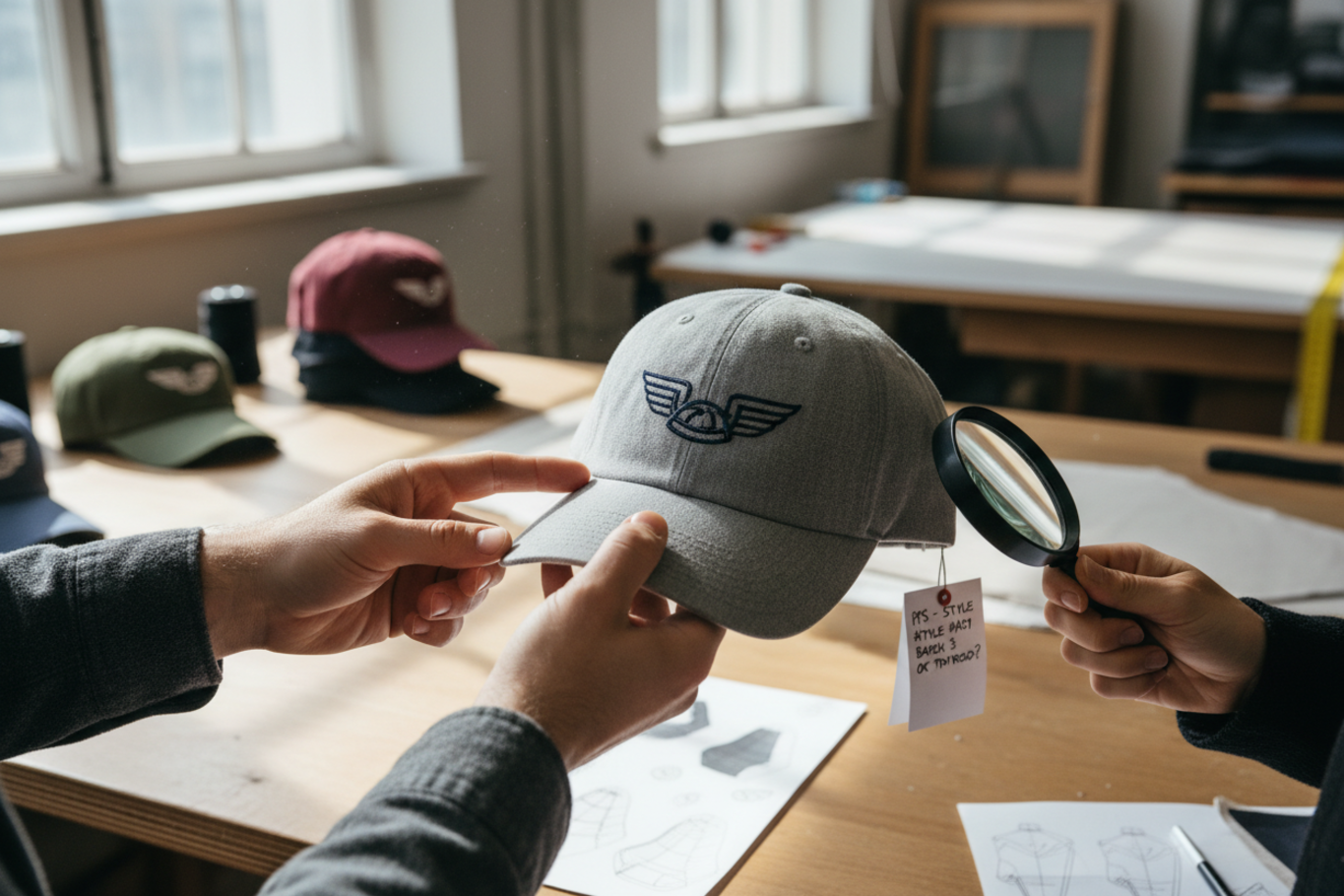
You might ask, "I already approved a sample, why do I need another one?" This is a great question. The first sample (Initial Sample) is often made with available stock materials. For example, if you want a specific Navy Blue, I might use a generic Navy Blue stock fabric for the initial design check because dyeing custom fabric takes too long for just one hat. However, the PPS is different.
The PPS happens after you place the order and after we source the bulk fabric and accessories. It represents exactly what the factory is about to make 500 times. I once had a client who wanted a specific metal buckle. The initial sample had a plastic one because we were waiting for the metal mold. If he had skipped the PPS, he would not have seen that the metal buckle was slightly too heavy for the strap until 1,000 hats were finished. Because we made a PPS, we caught the issue. We reinforced the strap before mass production started.
Here is why the PPS is your safety net:
- Dye Lot Verification11: It proves the actual fabric color matches your Pantone requirement12 under real light.
- Embroidery Clarity13: Sometimes bulk embroidery machines14 run differently than sample machines. The PPS confirms the logo is clean.
- Construction Test15: It tests if the heavy fabric works well with the chosen stiffener (buckram)16.
If you reject the PPS, we lose a few days. If you reject the bulk order, you lose your entire investment. Always ask for a PPS.
Why does mass production sometimes differ from samples?
You might wonder why a factory cannot just copy the sample exactly if they have the machine and the materials.
Samples are usually made by one master sewer with unlimited time, while bulk orders are made by a line of workers focusing on speed and efficiency.
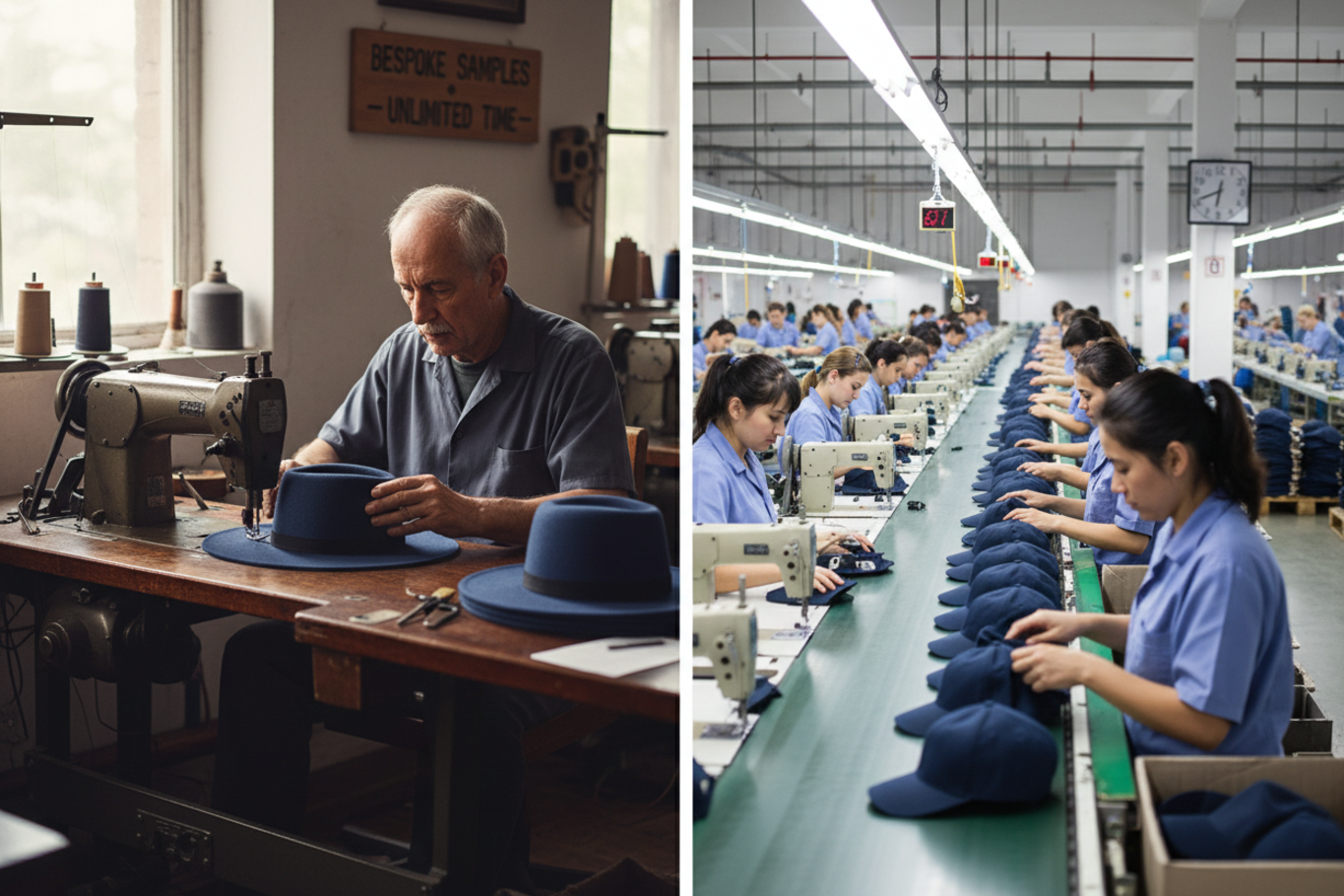
This is a reality of manufacturing that I think is important to share. When I make your initial sample, I give it to my best sample maker. She might spend three hours on one hat. She irons every seam perfectly flat. She adjusts the machine tension manually for that specific fabric. She treats it like a piece of art because she knows you are judging our quality based on this one item.
Mass production is different. It is an assembly line. One person cuts the fabric. Another person sews the front panels. A third person attaches the brim. A fourth person adds the sweatband. While these workers are very skilled, they are working fast. They might handle 500 hats a day. Because many hands touch your hat, slight variations can happen. This is the "human element."
Also, machines behave differently during long runs. An embroidery machine running for 8 hours straight gets hot. The thread tension might loosen slightly after the 100th hat. If the operator does not notice immediately, you might get five hats with slightly looser stitching.
There is also the issue of "Tolerance." In clothing and headwear, exact precision to the millimeter is impossible. Fabric stretches and shrinks.
- Sample: Exact fit (0 tolerance).
- Bulk: Acceptable tolerance (+/- 0.5cm).
Understanding this helps you set realistic expectations. It is not that the factory is careless; it is that mass manufacturing is a different mechanical process than sample making. My job at Anthea is to minimize this gap so you cannot tell the difference.
How do factories control quality during large-scale hat production?
You cannot fly to China to check every single stitch yourself, so you need to know how we do it for you.
We use a multi-stage inspection process that includes inline checks, embroidery validation, and a final shaping review to catch bad hats before they are packed.
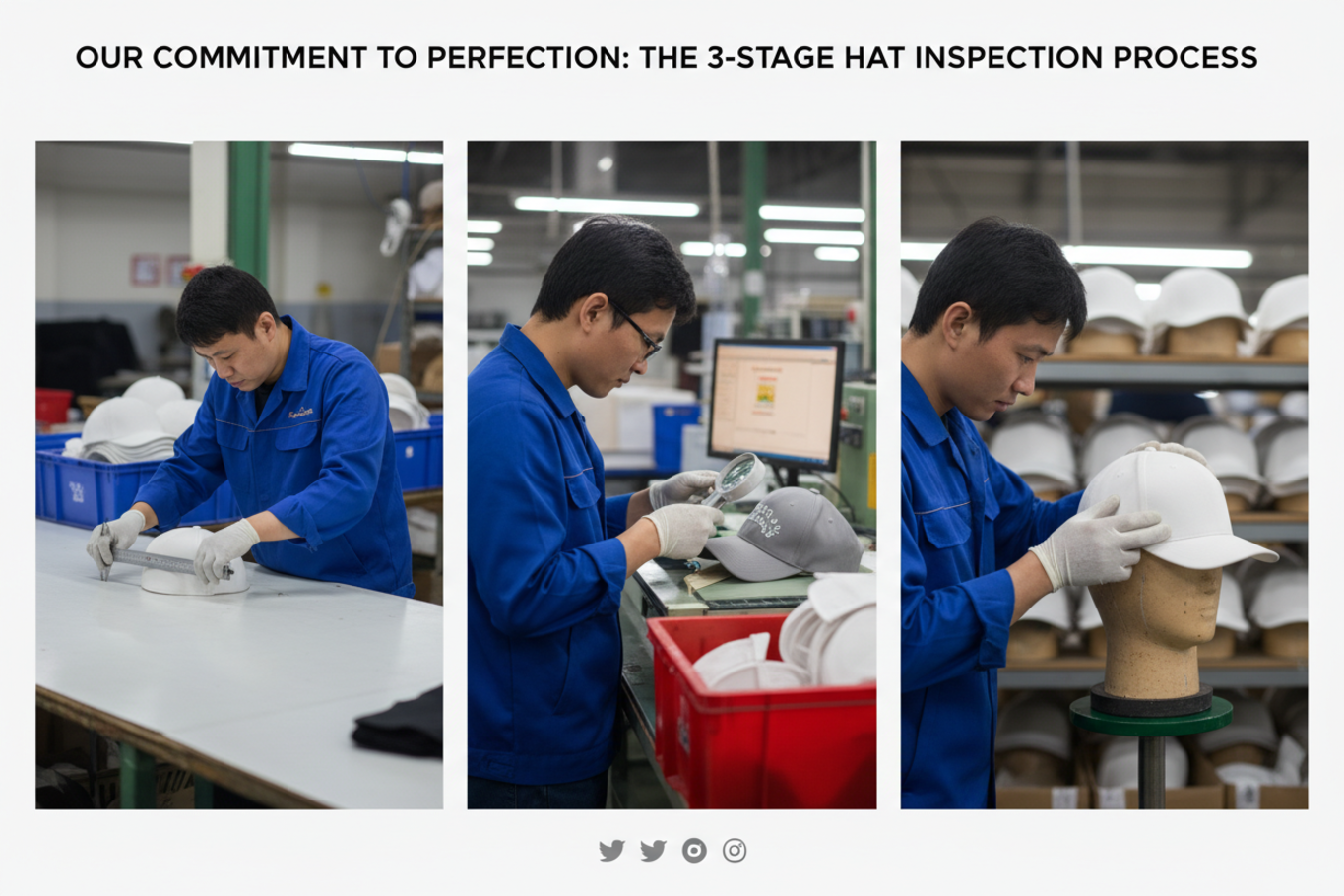
Quality Control (QC) is not just looking at the finished hat at the end. If we wait until the end, it is too late to fix a problem inside the seams. At Anthea, I enforce a system called "Inline QC17." This means we check the quality at every single step of the manufacturing journey.
Here is how we break down the inspection to ensure the bulk order matches the sample:
- Material Inspection: Before we even cut the fabric, we unroll it and check for flaws, holes, or color shading. If the fabric is bad, the hat will be bad.
- Cut Piece Inspection: After cutting the panels, we check if the shapes are accurate. If the triangle panels are wrong, the hat will be crooked.
- Logo Inspection: This is critical. We check the embroidery panels before the hat is sewn together. If the logo is crooked, we throw that panel away. It is cheaper to waste one piece of fabric than a whole finished hat.
- Sewing Floor Inspection: My QC managers walk the lines. They pick up random hats while they are being sewn. They check for "loose threads," "skipped stitches," or "puckering seams."
- Final Inspection: This happens after the hat is steamed and shaped. We check the overall look. Is the brim curved correctly? Is the sweatband clean? Is the size sticker correct?
We also perform a "pull test" on buttons and closures to make sure they do not fall off. By filtering out the bad units at each stage, the final box that arrives at your door only contains the winners. This systematic approach is the only way to replicate the quality of that first perfect sample.
What should be documented before bulk hat production starts?
Verbal agreements and WeChat messages are not enough when you are investing serious money into your inventory.
You need a comprehensive Tech Pack, a signed Purchase Order, and approved physical samples with clear notes to protect both your brand and the factory.
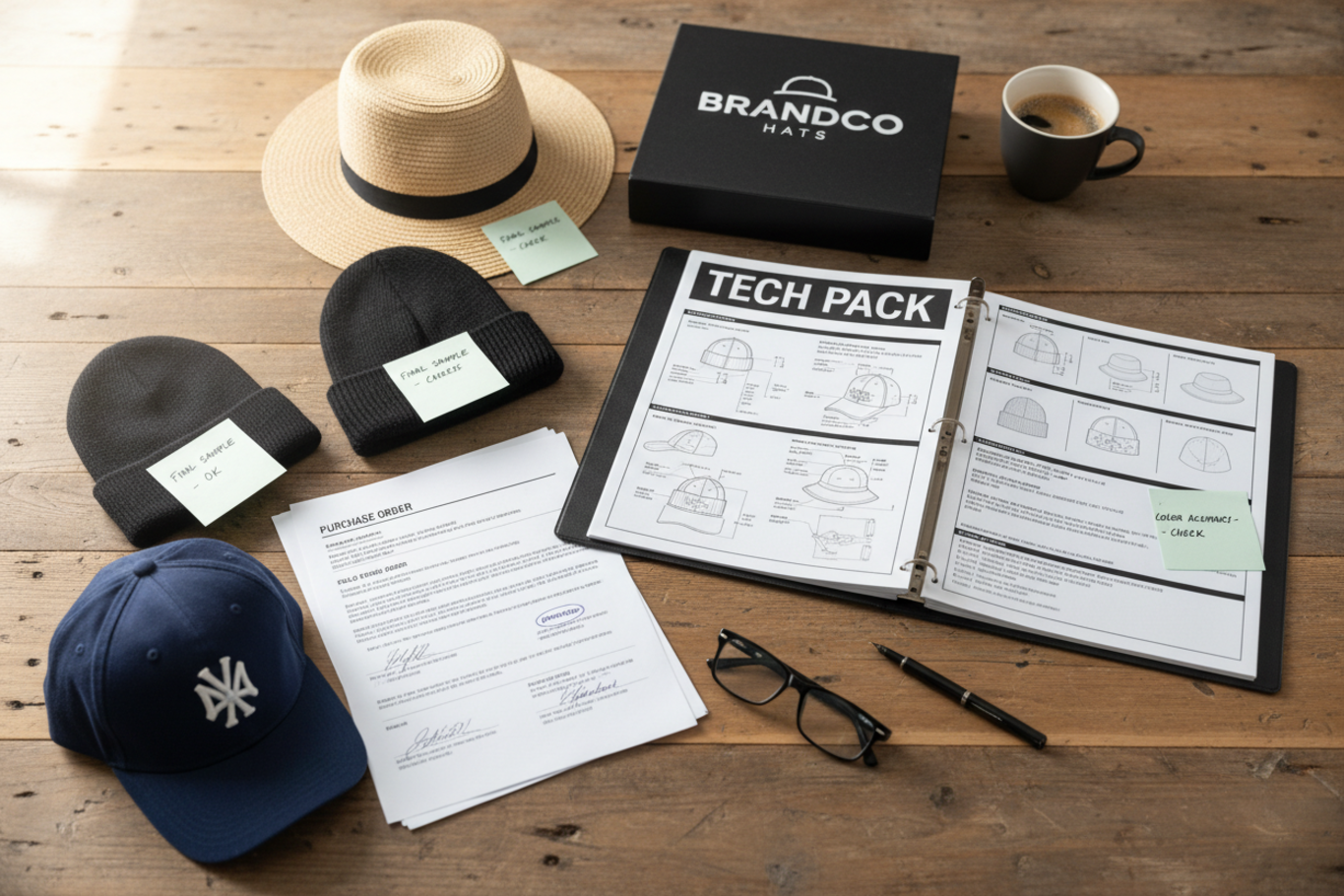
I have seen many problems arise because things were "said" but not "written." In manufacturing, if it is not on paper, it does not exist. To ensure your bulk production matches your sample, you need a "Bible" for your project. We call this the Tech Pack.
Your Tech Pack should be the final authority. It must include:
- Pantone Colors: Do not just say "Red." Say "Pantone 186C." This removes any argument about color shades.
- Measurements: Define the crown height, brim length, and circumference.
- Logo Files: Vector files (AI or PDF) with exact dimensions (e.g., "Logo width: 5.5cm").
- Material Details: Specify the fabric type (e.g., "100% Cotton Twill, 280gsm").
In addition to the Tech Pack, you need a "Signed Sample." When you approve the PPS, you should ask the factory to keep one, and you keep one. You should sign the tag on the factory’s copy. This confirms, "I approve this exact hat." If the bulk order comes and the logo is smaller, you can compare it to your signed sample. It gives you power.
Finally, your Purchase Order (PO)18 should state your quality standards. You can include a line like: "Acceptable Quality Limit (AQL) 2.519." This is a standard industry term regarding how many defects are allowed. It sounds strict, but it helps us understand that you are a professional buyer. When I see a client with clear documentation, I respect them more, and my team pays extra attention to their order because we know they are checking the details.
Conclusion
Samples are a promise of what is to come. To ensure I keep that promise, you must use Pre-Production Samples, clear Tech Packs, and understand the manufacturing process.
-
Understand PPS best practices so your bulk order matches the approved prototype and costly mistakes are caught early. ↩ ↩
-
Learn how bulk-material PPS reduces color/handfeel surprises and ensures true-to-production quality. ↩ ↩
-
A strong tech pack prevents misunderstandings on materials, sizing, and branding—protecting your order and timeline. ↩
-
Helps you define acceptable variation (+/-) so you avoid disputes and get consistent fit across production. ↩
-
Shows how factories use an approved master reference to keep every station aligned to the same standard. ↩
-
Learn why more operators and handoffs increase variation and what controls reduce that risk. ↩ ↩
-
Explains how a tagged master sample becomes the on-line rulebook for measurements, placement, and workmanship. ↩
-
Get practical standards to avoid visible inconsistencies that make products look lower quality. ↩
-
Prevents crooked/misaligned branding by using measurable placement rules and reference points. ↩
-
Learn verification methods (GSM/handfeel/testing) to keep the final product feeling identical to the sample. ↩
-
Avoids shade mismatches by learning light-box checks and dye-lot control steps. ↩
-
Helps you translate brand colors into production-ready specs and reduce color disputes. ↩
-
Explains digitizing, stabilizers, density, and machine settings to keep logos crisp at scale. ↩
-
Understand machine variance so you can demand correct testing/approval before full runs begin. ↩
-
Learn how to test structure and durability before cutting all fabric—reducing rework and rejects. ↩
-
Find guidance on buckram types/weights so the hat holds shape without discomfort or failure. ↩
-
Shows how checking during each step catches defects early—cheaper than end-of-line fixes. ↩
-
A solid PO locks specs, QC expectations, and accountability—reducing costly ‘he said/she said’ issues. ↩
-
Learn the defect tolerance standard so you can set enforceable QC terms with your factory. ↩