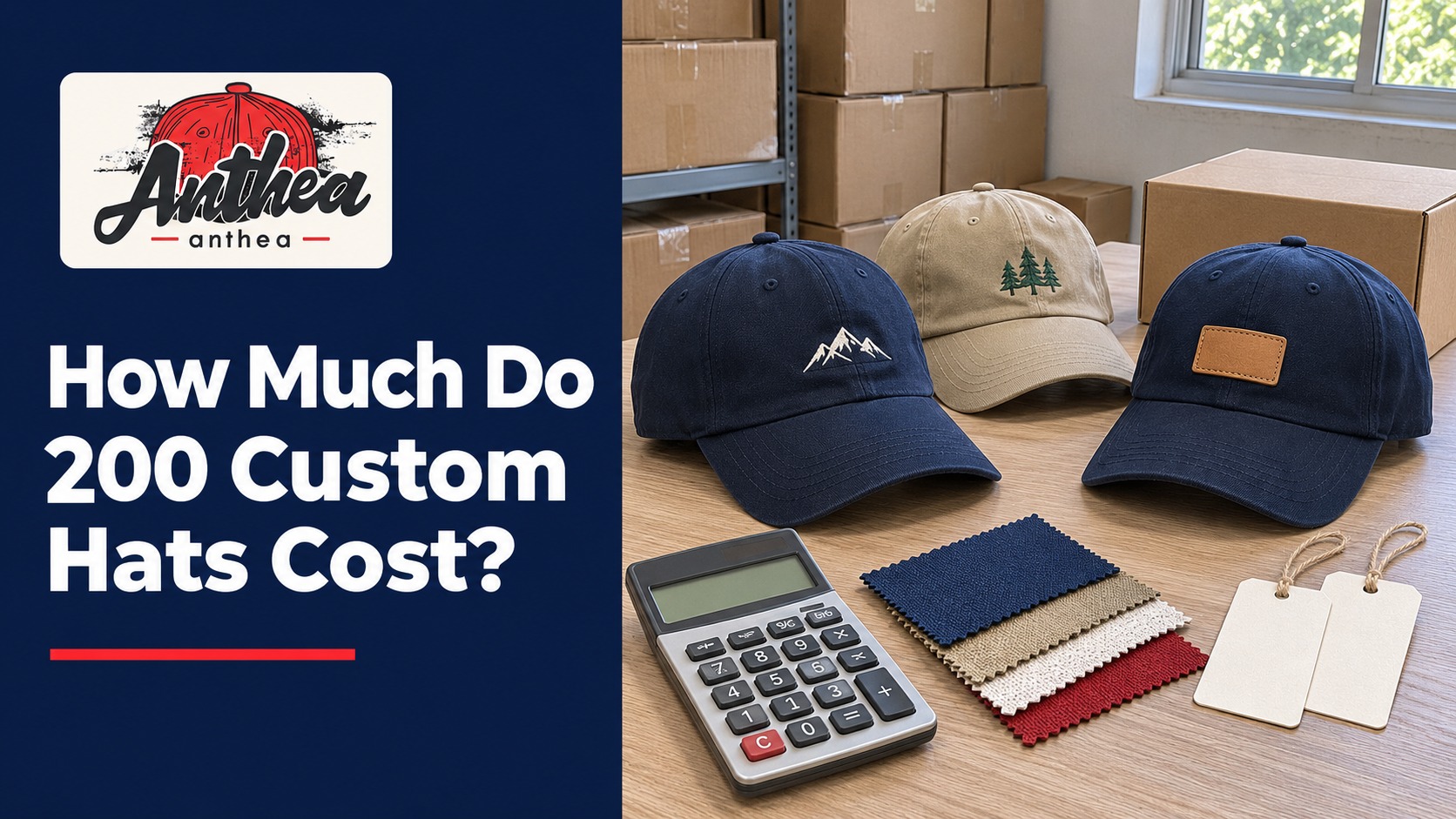
200 custom hats can look simple at first, but the price can change fast once I add style, fabric, logo method, packaging, sampling, and shipping1. If I only ask for “unit price × 200,” I may miss setup costs and small-order premiums2. A better approach is to price the full sourcing package.
The cost of 200 custom hats usually depends on the hat style, material, logo technique, packaging, sampling, supplier MOQ, delivery country, and deadline. As a cautious reference, simple promotional caps may land around a few dollars per piece, while embroidered, patch, or premium hats can cost much more before shipping and taxes.

I have seen many small-batch quotation discussions where the buyer wants a quick number, but the supplier needs a clearer specification first. The details below explain how factories often think about pricing, so I can compare quotes more fairly and avoid surprise costs.
How Much Do 200 Custom Hats Cost in Real Factory Quotation Practice?
A buyer often wants one clear number, but 200 custom hats are rarely priced from the hat body alone. The problem is that each design choice affects cost. The risk is that a low first quote may exclude logo setup, sampling, packaging, or freight. I prefer to estimate the full order value first.
For 200 custom hats, I usually treat the price as a conditional range, not a fixed market rate. A simple cap with basic printing may be relatively low-cost, while embroidery, woven patches, special fabrics, private packaging, or urgent delivery can raise the total. The final quote depends on the complete specification.

Why a single universal price does not work
In factory quotation practice, I do not see 200 custom hats as a pure commodity order. I see it as a small-batch custom project3. That means the supplier must prepare materials, arrange logo work, confirm colors, make samples, and handle packaging for a limited quantity. Those fixed steps do not disappear just because the order is small4.
A practical reference can help, but it must stay conditional. For many basic overseas sourcing cases, I would expect rough factory-side pricing to vary like this:
| Hat Type / Customization Level | Possible Factory-Side Reference | Common Notes |
|---|---|---|
| Basic cap with simple print | Lower range | Good for promotions, simple events, giveaways |
| Cotton cap with embroidery | Mid range | More durable logo effect, common for brands |
| Trucker hat with patch | Mid to higher range | Patch material and sewing add cost |
| Premium structured cap | Higher range | Better fabric, shape, lining, finishing |
| Custom packaging added | Extra cost | Polybag, hangtag, box, barcode, carton mark |
| Sample development | Extra cost | May be refundable or deducted later depending on supplier |
I avoid giving one exact number because several details can move the quote quickly:
- Hat style: baseball cap, snapback, dad hat, trucker hat, bucket hat, beanie.
- Fabric: cotton, polyester, canvas, twill, mesh, wool blend, recycled fabric.
- Logo method: embroidery, screen print, heat transfer, woven patch, leather patch, rubber patch.
- Packaging: individual polybag, custom hangtag, branded box, retail barcode.
- Shipping term: EXW, FOB, CIF, DDP, air freight, sea freight, express courier.
- Timeline: normal production or urgent production.
For 200 pieces, I often advise buyers to think in total project cost, not only unit cost. A supplier may quote the hat at a reasonable unit price, but the buyer still needs to account for logo setup, sample cost, packaging, inland transport, export handling, international freight, import duty, and local delivery.
My practical rule is simple: if the order is small and customized, the “cheapest unit price” is not always the cheapest final order.
If I were planning a small brand launch or event order, I would prepare a budget with a buffer. I would not assume that 200 pieces receive the same factory efficiency as 2,000 or 20,000 pieces. The factory still needs to set up production, check the logo, and control quality. That setup cost must be recovered somewhere.
Why Do 200 Custom Hats Usually Cost More Per Piece Than Bulk Orders?
The main issue with 200 custom hats is that the order is often too small for true mass-production efficiency. A buyer may expect wholesale pricing, but a factory still needs setup time, sample checking, logo preparation, and packaging work. If I ignore those fixed costs, my budget may be too low.
200 custom hats usually cost more per piece than larger orders because fixed costs are spread across fewer units.5 These costs may include sample development, logo digitizing, machine setup, material sourcing, carton preparation, and order handling. Larger orders spread the same preparation work over more pieces, so the unit price often drops.
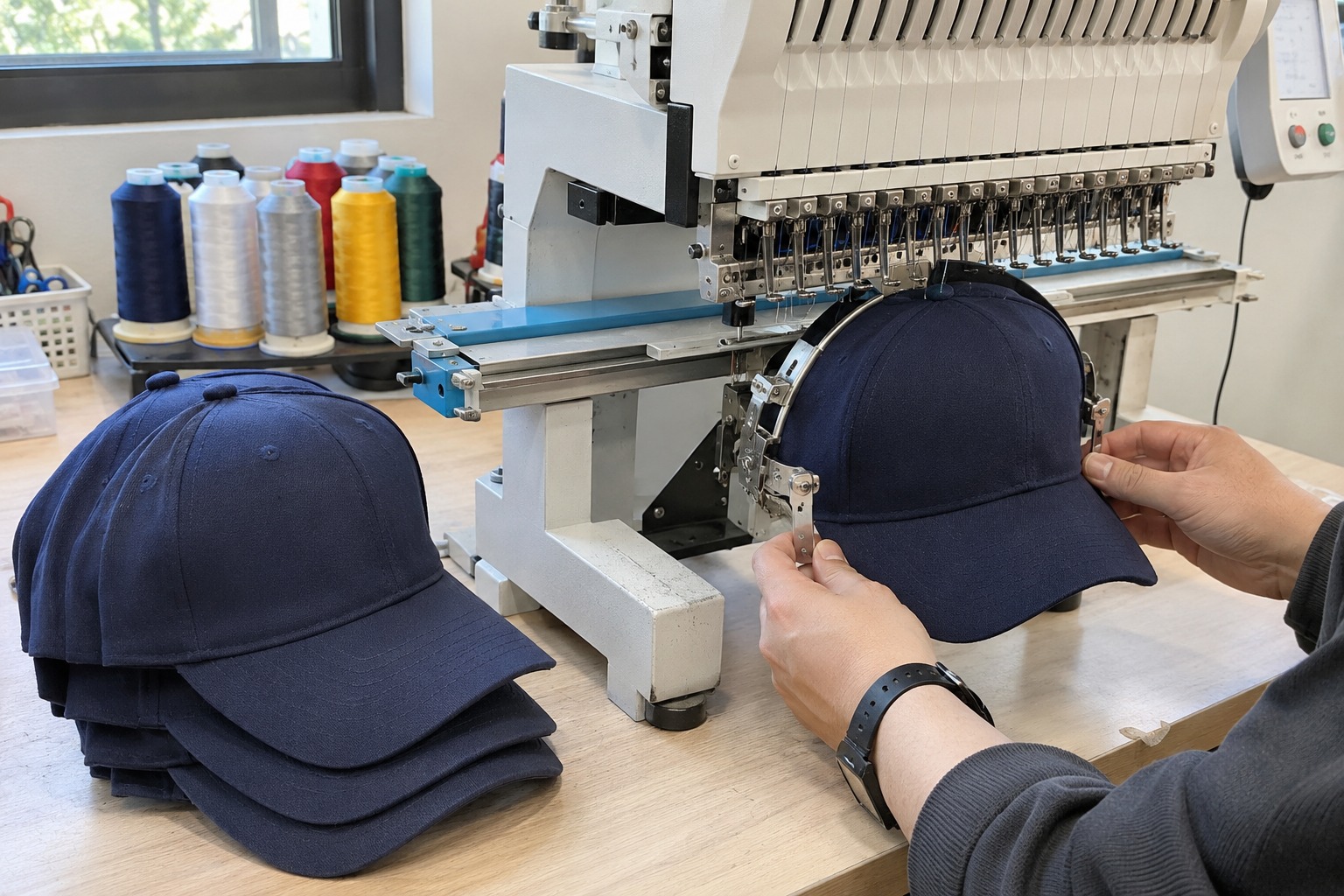
200 pieces is often a trial order, not a bulk order
When I discuss 200 custom hats with suppliers, I usually treat the quantity as a trial order, event order, or market test order. It is useful, but it is not large enough to give the buyer maximum pricing leverage.
A factory may accept 200 pieces, but that does not mean the factory can price it like a container-level order. The supplier may still need to:
- Source fabric or use available stock fabric.
- Confirm the hat mold or structure.
- Digitize the embroidery file or prepare printing screens.
- Make a pre-production sample.
- Adjust logo size or position.
- Arrange cutting, sewing, finishing, and inspection.
- Pack 200 pieces according to the buyer’s request.
- Prepare export cartons and shipping documents.
These steps take time. Some steps cost almost the same whether the order is 200 pieces or 2,000 pieces. That is why the small-batch premium matters.
How MOQ affects price
MOQ means minimum order quantity.6 Some hat factories may accept 200 pieces for simple styles, especially if they use existing fabric and standard colors. However, MOQ can become higher when the buyer requests:
- Custom dyed fabric
- Special material
- Custom buckle or closure
- Custom lining
- All-over printing
- Multiple logo positions
- Multiple sizes or colors
- Custom retail packaging
If I split 200 hats into four colors, each color has only 50 pieces. This can increase cost or create production difficulty. If I split 200 hats into many logo designs, each design may require its own setup charge. Small changes can make the order less efficient.
The common cost pressure points
Here is how I usually break down the reason small orders cost more:
| Cost Pressure Point | Why It Matters for 200 Pieces |
|---|---|
| Setup cost | The supplier still prepares machines, files, materials, and staff time |
| Logo preparation | Embroidery digitizing or printing setup may be charged separately |
| Material sourcing | Special fabric may require higher MOQ than 200 pieces7 |
| Color splitting | Too many colors reduce production efficiency8 |
| Packaging customization | Small runs of hangtags or boxes may carry high unit cost |
| Freight | Shipping small quantities can be expensive per hat |
| Communication time | Quotation, proofing, revision, and inspection still require staff time |
I always recommend asking whether the quote includes setup fees. If the supplier says “unit price includes logo,” I still ask what logo method, logo size, and logo position are included. A 5 cm embroidered front logo and a large 3D puff embroidery design are not the same production job.
A small buyer can still control cost. I usually suggest:
- Choose one main hat style.
- Use one or two colors only.
- Keep the logo in one standard position.
- Use a supplier’s stock fabric color.
- Avoid overly complex packaging for a first order.
- Ask for a sample before mass production.
- Compare quotes using the same specification.
This approach makes the 200-piece order easier for the supplier and more predictable for the buyer.
What Cost Items Should I Include When Pricing 200 Custom Hats?
The biggest mistake I see is pricing 200 custom hats as only “blank hat plus logo.” That view is too narrow. The real order may include material upgrades, logo setup, sample cost, packaging, carton marking, shipping, taxes, and payment fees. If I miss these items, the final landed cost may surprise me.
When pricing 200 custom hats, I include the hat body, fabric, structure, logo customization, sample cost, packaging, labels, inspection, inland transport, international shipping, import duties, and local delivery. I also check whether the quotation term is EXW, FOB, CIF, or DDP9 because each term includes different responsibilities.

A practical cost breakdown
I like to build a quotation checklist before asking a supplier for price. This helps me compare different suppliers fairly. A low quote may look attractive, but it may exclude several costs that another supplier already included.
Here is a simple cost structure:
| Cost Item | What It Means | Questions I Ask |
|---|---|---|
| Blank hat/base style | The basic hat before logo | Is it dad hat, snapback, trucker, bucket hat, or beanie? |
| Material | Fabric and trims | Is it cotton, polyester, mesh, canvas, or blended fabric? |
| Structure | Shape and construction | Is it structured, unstructured, 5-panel, 6-panel, or foam front? |
| Logo customization | Branding method | Is it embroidery, print, patch, label, or heat transfer? |
| Sample | Pre-production confirmation | Is the sample charged? Can it be refunded after order? |
| Packaging | Individual and outer packing | Is each hat polybagged? Are hangtags or boxes needed? |
| Labels | Inside label, woven label, size label | Are brand labels included or extra? |
| Inspection | Quality check before shipment | Is there internal QC or third-party inspection? |
| Inland transport | Factory to port or warehouse | Is this included in FOB or billed separately? |
| International freight | Sea, air, courier | Which method fits the deadline and budget? |
| Import cost | Duty, VAT, clearance | Who pays customs charges in the destination country? |
| Payment fees | Bank or platform fees | Are transaction fees included? |
Why shipping terms matter
The shipping term can change the buyer’s real cost. If I compare a cheap EXW quote with a higher FOB quote, the EXW quote may not actually be cheaper.
Common terms include:
- EXW: The buyer handles pickup from the factory and almost all logistics.
- FOB: The supplier delivers goods to the export port and handles export-side processes.
- CIF: The supplier includes sea freight to the destination port, but not all destination charges.
- DDP: The supplier includes delivery to the buyer’s address, often including customs handling.
For 200 hats, many buyers use express courier or air freight because the shipment is small and time-sensitive. However, courier cost per hat can be high10. If the deadline is flexible, sea freight may reduce transport cost, but it may take longer and may not be practical for all small shipments.
Packaging can quietly increase cost
Packaging seems simple, but it affects labor, materials, and carton size.11 If I only need promotional hats for an event, a standard polybag may be enough. If I sell hats online, I may need barcode labels, hangtags, dust bags, or a branded box.
The difference matters. A simple packing plan may include:
- 1 hat per polybag
- 25 or 50 hats per carton
- Neutral carton mark
- Basic export carton
A retail packing plan may include:
- Custom hangtag
- Branded inner label
- Barcode sticker
- Color-size label
- Custom box or mailer
- Special folding or shape protection
If I request premium packaging for only 200 pieces, the packaging supplier may also have MOQ limits. That can raise the unit cost.
A better way to compare quotes
I prefer to ask suppliers for a line-item quote. This makes the quote transparent. I may ask:
- Hat unit price with material and style stated.
- Logo cost by method, size, and position.
- Sample cost and sample lead time.
- Mass production lead time.
- Packaging cost.
- Carton size and gross weight.
- Shipping term.
- Estimated freight cost to my country.
- Payment terms.
- Validity period of the quotation.
This method prevents confusion. It also helps me negotiate in a professional way. Instead of saying “your price is too high,” I can ask whether cost would drop if I use a stock color, simplify packaging, reduce logo size, or increase quantity.
How Do Logo Methods Change the Cost of 200 Custom Hats?
Logo method is one of the fastest ways to change the cost and look of 200 custom hats. A buyer may think embroidery, printing, woven labels, and patches are interchangeable. They are not. Each method has different setup needs, durability, texture, minimums, and visual results.
The logo method changes both the price and final appearance of 200 custom hats.12 Embroidery often looks durable and professional, printing can work well for flat graphic designs, woven labels suit small brand details, and patches create a premium look. The best choice depends on logo artwork, budget, fabric, and target use.
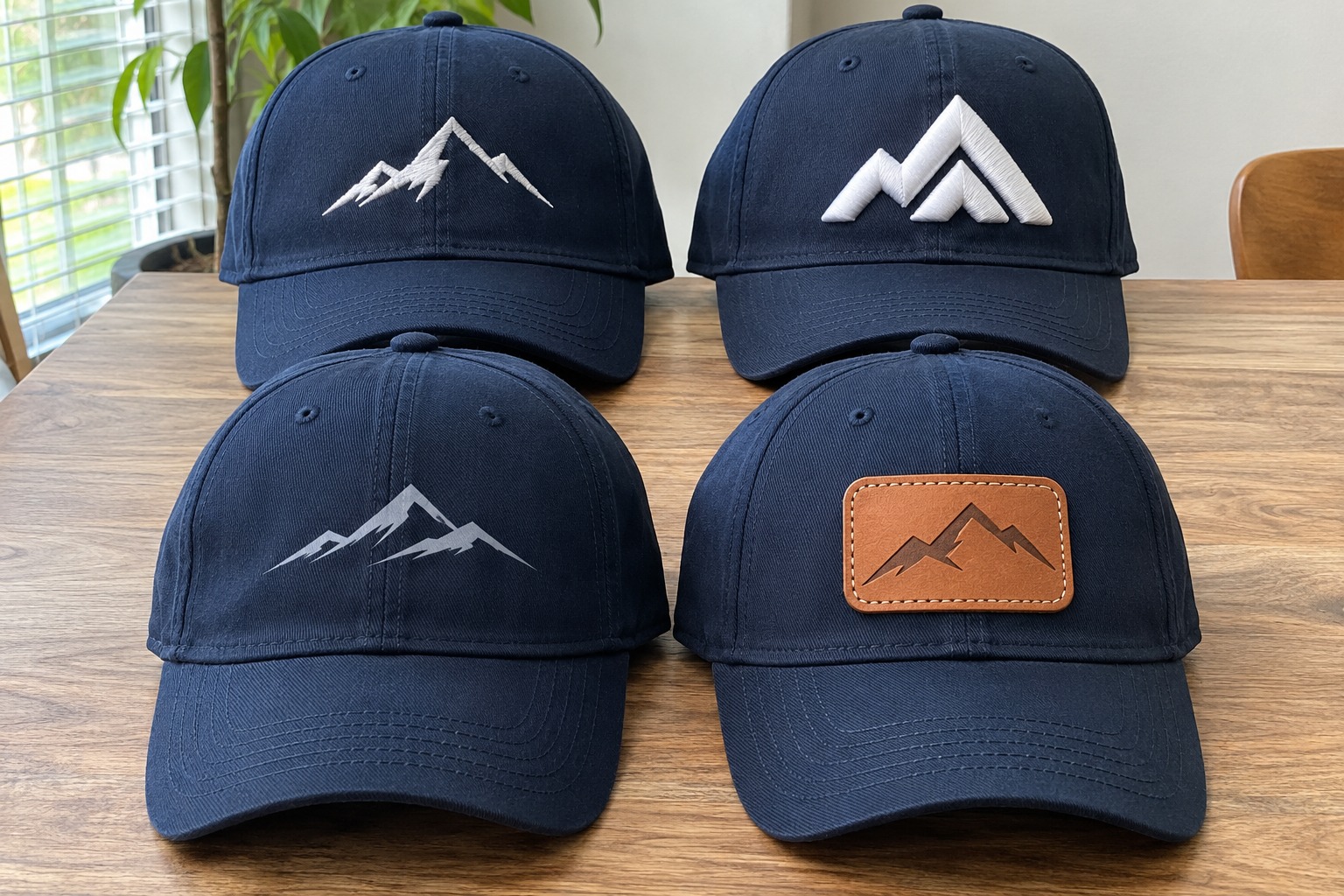
Common logo methods compared
When I help review custom hat specifications, I usually look at the logo first. The logo tells me whether the design is simple, detailed, flat, raised, colorful, or texture-heavy. That decision affects the production route.
| Logo Method | Best For | Cost Impact | Appearance |
|---|---|---|---|
| Flat embroidery | Text, simple icons, standard brand logos | Medium | Professional and durable |
| 3D puff embroidery | Bold letters, sports-style logos | Higher | Raised, thick, noticeable |
| Screen printing | Simple graphics, larger flat areas | Low to medium | Clean and flat |
| Heat transfer | Multi-color designs, gradients | Medium | Smooth, graphic look |
| Woven patch | Detailed logos, labels, brand marks | Medium to higher | Clean, textile texture |
| Leather patch | Lifestyle or premium branding | Higher | Premium and tactile |
| Rubber/PVC patch | Outdoor, sports, streetwear | Higher | Modern and durable |
| Woven label | Side or back branding | Low to medium | Subtle and neat |
Why embroidery is not always the cheapest choice
Many buyers ask for embroidery because it feels like the standard option for custom caps. I agree that embroidery often works well. However, the cost depends on stitch count, logo size, thread colors, and complexity.
A small text logo may be affordable. A large dense logo can cost more because it uses more thread and machine time. If the logo has tiny details, the result may also lose clarity. I usually ask for the logo file before recommending embroidery.
For embroidery, I check:
- Logo width and height
- Number of thread colors
- Stitch density
- Flat or 3D puff effect
- Front, side, back, or multiple positions
- Fabric type and panel shape
Why patches can raise the order value
Patches can make 200 custom hats look more premium, but they add more steps. The patch must be produced first, then attached to the hat. A leather patch may require debossing, printing, cutting, and sewing. A rubber patch may require mold or tooling. A woven patch may have its own MOQ and sample process.
That does not mean patches are a bad choice. For ecommerce brands, lifestyle merchandise, outdoor teams, or higher-end promotional gifts, patches may create a better perceived value. However, I would not treat them as the same cost category as a simple printed logo.
Matching logo method to buyer goal
I usually match the logo method to the purpose of the hats:
- Event giveaway: simple print or basic embroidery may be enough.
- Startup merch: embroidery or woven patch may look more brand-ready.
- Streetwear drop: 3D embroidery, rubber patch, or special label may fit better.
- Outdoor promotion: PVC patch or durable embroidery may be more suitable.
- Corporate gift: clean embroidery with good packaging may feel professional.
The key is to avoid choosing only by price. A cheap logo method that looks poor can hurt the brand. At the same time, a premium logo method may not make sense for a one-day event giveaway. I try to match cost, appearance, and purpose.
Before confirming mass production, I strongly prefer seeing a physical sample or at least a clear pre-production photo. Logo placement can look different on a curved hat panel than it does on a flat digital mockup.
What Information Should I Send to Get an Accurate Quote for 200 Custom Hats?
A vague inquiry for 200 custom hats usually gets a vague quote. If I only write “How much for custom caps?” the supplier must guess the style, fabric, logo method, packaging, and shipping. Those guesses can create wrong pricing. I get better quotes when I send a complete specification from the start.
To get an accurate quote for 200 custom hats, I should send the quantity, hat type, material preference, color, logo file, logo size, logo method, logo position, packaging needs, delivery country, shipping term, deadline, and sample requirement. Clear information helps the supplier quote faster and reduces later price changes.
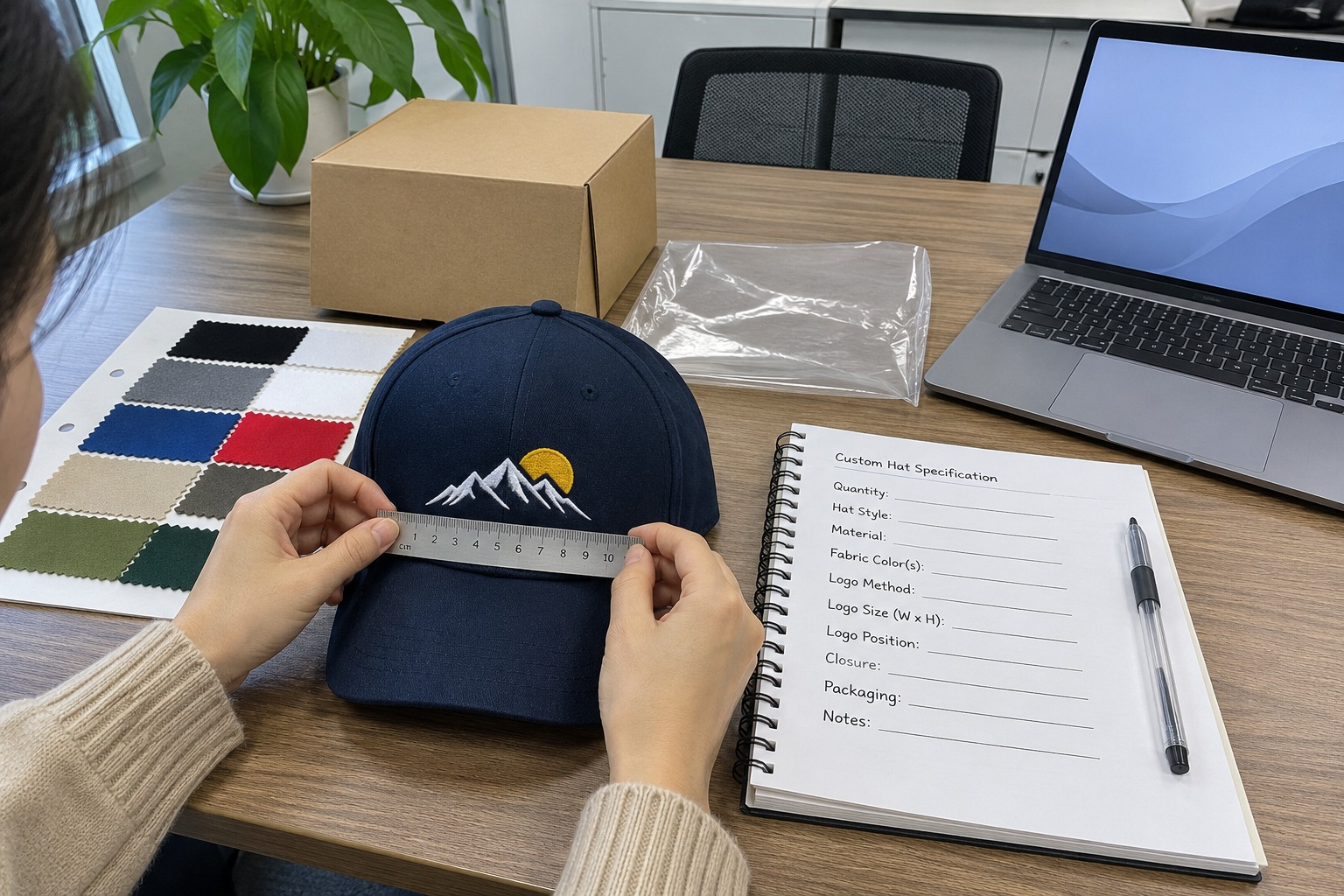
The quotation details I prepare
In my own small-batch sourcing discussions, I like to prepare a short message that removes guesswork. Suppliers can quote more accurately when the request is structured.
A strong inquiry includes:
- Quantity: 200 pieces.
- Hat type: baseball cap, snapback, dad hat, trucker hat, bucket hat, beanie.
- Material: cotton twill, polyester, mesh, canvas, wool blend, or open to recommendation.
- Color: black, white, navy, khaki, custom Pantone, or assorted colors.
- Logo file: AI, PDF, SVG, EPS, or high-resolution PNG.
- Logo size: width and height in centimeters or inches.
- Logo position: front, side, back, brim, inside label.
- Logo method: embroidery, print, patch, woven label, heat transfer.
- Packaging: individual polybag, hangtag, barcode, box, carton mark.
- Destination: country, city, and postal code if courier quote is needed.
- Deadline: delivery date or event date.
- Sample request: photo sample, physical sample, or pre-production sample.
- Shipping term: EXW, FOB, CIF, DDP, courier, air, or sea.
A sample inquiry message
I might write something like this:
Hello, I need a quote for 200 custom hats. The style is a black cotton dad hat with adjustable metal buckle. I need one front logo, flat embroidery, about 6 cm wide. I can send the logo file in AI format. Please quote the unit price, sample cost, sample lead time, production lead time, packaging cost, carton size, and shipping cost to [country/city]. I prefer individual polybags and standard export cartons.
This message is not long, but it gives the supplier enough information to price the order more responsibly.
Questions I ask before paying
Before I approve a 200-piece custom hat order, I ask several practical questions:
- Is the quoted price based on stock fabric or custom fabric?
- Does the price include logo setup?
- Is the sample fee refundable after bulk order?
- What is the sample lead time?
- What is the mass production lead time?
- What file format is needed for the logo?
- Can the supplier provide photos or videos before shipment?
- What is the carton size and gross weight?
- What happens if there is a quality issue?
- Are the hats inspected before packing?
These questions do not make me difficult as a buyer. They make the order clearer. Good suppliers usually appreciate clear communication because it reduces revisions, disputes, and production delays.
How lead time changes cost and risk
For 200 custom hats, a normal timeline may still require time for sampling and production. If I need the hats urgently for an event, I may have fewer choices. The supplier may need to use available materials, skip some customization options, or ship by air. That can increase cost.
A realistic timeline may include:
| Step | Typical Consideration |
|---|---|
| Quotation | 1–3 days if specs are clear |
| Artwork confirmation | 1–3 days depending on revisions |
| Sample production | Several days to 2 weeks depending on method |
| Sample shipping | A few days by courier |
| Mass production | Often 2–4 weeks, but varies by factory and season |
| International shipping | Courier is faster; sea freight is slower |
I do not treat these numbers as universal rules. I treat them as planning references. The final lead time depends on supplier capacity, material availability, logo complexity, approval speed, and shipping route.
Frequently Asked Questions
Is 200 custom hats enough for a factory order?
Yes, 200 custom hats can be enough for some suppliers, especially when the style is simple and uses stock materials. However, 200 pieces may still be treated as a small-batch or trial order. I would expect less pricing leverage than larger quantities.
What is the cheapest logo method for 200 custom hats?
The cheapest method depends on the design, but simple printing or basic embroidery may be cost-effective for many small orders. I do not choose by price alone. I also check durability, fabric compatibility, logo clarity, and whether the final look fits the brand.
Do I need a sample before ordering 200 custom hats?
I strongly prefer a sample for custom hats because logo size, placement, color, and stitching can look different in real life. A sample may add cost and time, but it reduces the risk of receiving 200 hats with the wrong appearance.
Why did two suppliers quote very different prices?
Two suppliers may quote different prices because they include different materials, logo methods, packaging, shipping terms, or quality levels. One quote may include setup and packaging, while another may not. I compare line items before deciding which quote is truly better.
Can I reduce the cost of 200 custom hats?
Yes, I can reduce cost by choosing stock colors, using one logo position, simplifying the logo method, limiting color variations, using standard packaging, and allowing normal lead time. I can also ask the supplier how price changes at 300, 500, or 1,000 pieces.
Conclusion
The cost of 200 custom hats is not a simple “unit price × 200” question. I need to consider style, fabric, structure, logo method, sampling, packaging, lead time, shipping, and supplier MOQ. A clear specification helps me get a more accurate quote and avoid hidden costs. If you also evaluate factory quotations for export products, you can use this same sourcing logic when comparing suppliers. For hardware sourcing support from Dingzhou Best, contact us at [email protected] or WhatsApp +8618331061136.
-
"8. Calculate Packaging Cost per Order", https://pressbooks.cuny.edu/packaging/chapter/packaging-cost-per-order/. University-level apparel costing guidance identifies materials, construction labor, trims, packaging, sampling, overhead, and logistics as components that can affect garment quotations, supporting the article’s treatment of these factors as cost variables; the support is contextual rather than a direct price study of 200 custom hats. Evidence role: general_support; source type: education. Supports: A garment or apparel costing source should support that material choice, construction, decoration, packaging, sampling, and logistics are standard cost variables in apparel production.. Scope note: Contextual support for apparel costing generally, not direct proof of hat-specific prices. ↩
-
"Economies of scale", https://en.wikipedia.org/wiki/Economies_of_scale. Manufacturing economics literature describes setup costs as batch-level costs that are incurred before production and then allocated across output, supporting the article’s claim that small customized orders can carry higher effective per-unit costs; the source would not establish the exact premium charged by any hat supplier. Evidence role: mechanism; source type: paper. Supports: A manufacturing economics paper should explain that setup costs are batch-level or fixed costs that must be allocated across the number of units produced.. Scope note: Supports the cost mechanism generally, not a measured premium for custom hats. ↩
-
"Process Planning for Small Batch Manufacturing – Sites at USC", https://sites.usc.edu/skgupta/process-planning-for-small-batch-manufacturing/. Research on small-batch and make-to-order manufacturing characterizes such production as low-volume, higher-variety work that requires planning and setup for specific customer requirements, supporting the article’s classification of a 200-piece customized hat order as a small-batch custom project; the source is not specific to headwear. Evidence role: definition; source type: paper. Supports: A manufacturing research source should define small-batch or make-to-order production as low-volume production with customization, planning, and setup requirements.. Scope note: Defines the production context generally rather than setting a universal threshold for hats. ↩
-
"Batch-Level Activities: Meaning, History, and Examples", https://www.investopedia.com/terms/b/batch-level-activities.asp. Activity-based costing materials identify setup, inspection, material handling, and order processing as batch-level activities incurred for a production run, supporting the article’s point that certain preparation steps remain necessary even for small orders; the evidence is general and does not quantify hat-factory labor time. Evidence role: mechanism; source type: education. Supports: An accounting or production-management source should explain batch-level activities and costs, such as setup, inspection, and material handling, that occur regardless of the number of units in the batch.. Scope note: General manufacturing-cost principle, not empirical evidence from hat factories. ↩
-
"Economies of Scale: Definition, Types, and Strategies", https://online.hbs.edu/blog/post/economies-of-scale. Economics teaching materials on economies of scale explain that average cost can decline as output increases because fixed costs are distributed across more units, supporting the article’s explanation for higher per-piece pricing in a 200-unit customized order; the source does not provide hat-industry price data. Evidence role: mechanism; source type: education. Supports: An economics or operations source should support the principle that average cost falls when fixed costs are spread over a larger number of units.. Scope note: Supports the economic mechanism, not a hat-specific cost curve. ↩
-
"Minimum Order Quantity (MOQ): Formula, Tips, & Benefits", https://www.netsuite.com/portal/resource/articles/inventory-management/minimum-order-quantity-moq.shtml. A procurement glossary defines MOQ as the minimum order quantity a supplier is willing to sell or produce, directly supporting the article’s definition of the sourcing term. Evidence role: definition; source type: institution. Supports: A procurement or supply-chain glossary should define MOQ as minimum order quantity.. ↩
-
"Sustainable Dyeing Techniques: Innovations in Coloring …", https://www.rmcad.edu/blog/sustainable-dyeing-techniques-innovations-in-coloring-fabrics/. Textile manufacturing guidance describes fabric dyeing and finishing as batch- or lot-based processes, supporting the article’s claim that custom or special fabrics may carry minimum quantities above a small 200-piece order; the source would contextualize the constraint rather than prove a specific factory MOQ. Evidence role: general_support; source type: education. Supports: A textile manufacturing source should explain that fabric production, dyeing, or finishing is commonly organized in batches or lots, which can impose minimum quantities.. Scope note: Contextual textile-production support, not a universal MOQ for every fabric or hat factory. ↩
-
"Improving Production Changeovers and the Optimization", https://www.sciencedirect.com/science/article/pii/S2351978917305644. Operations-management research links higher product variety and more frequent changeovers with additional setup time and lower production efficiency, supporting the article’s claim that splitting a 200-piece order into many colors can create inefficiencies; the evidence is general manufacturing evidence rather than a hat-line case study. Evidence role: mechanism; source type: paper. Supports: A production-management paper should support that increased product variety and changeovers can reduce efficiency by increasing setup time or reducing lot size.. Scope note: General manufacturing mechanism, not direct measurement from cap production. ↩
-
"Know Your Incoterms", https://www.trade.gov/know-your-incoterms. The International Chamber of Commerce’s Incoterms rules define EXW, FOB, CIF, and DDP as trade terms that allocate delivery, risk, transport, and customs responsibilities between seller and buyer, supporting the article’s warning that quotation terms change the buyer’s real cost. Evidence role: definition; source type: institution. Supports: The International Chamber of Commerce or an official Incoterms reference should support that these terms allocate transport, risk, export, import, and delivery responsibilities differently.. ↩
-
"Universal Postal Convention", https://www.upu.int/UPU/media/upu/files/aboutUpu/acts/02-actsGeneralRegulations/11_Convention_1.pdf. International logistics guidance on chargeable weight explains that air and parcel freight prices can depend on actual weight, volumetric weight, destination, and speed of service, supporting the article’s point that courier shipping may be expensive per hat for small orders; it does not provide a hat-specific freight quote. Evidence role: mechanism; source type: institution. Supports: A logistics institution should explain that air or parcel shipments are priced using chargeable weight, dimensions, route, and service level, which can raise per-unit costs for small shipments.. Scope note: Supports the pricing mechanism for small shipments, not the exact courier cost per hat. ↩
-
"THE CONCEPT OF PACKAGING LOGISTICS", https://www.poms.org/archive/conferences/Meeting2004/POMS_CD/Browse%20This%20CD/PAPERS/002-0283.pdf. Packaging logistics research identifies package design as a factor affecting material consumption, handling, storage space, and transport cube, supporting the article’s claim that packaging can change both labor and shipping-related costs; the evidence is not specific to hat packaging. Evidence role: general_support; source type: paper. Supports: A packaging logistics paper should support that package design influences material use, handling requirements, storage space, carton dimensions, and transport efficiency.. Scope note: General packaging-logistics support, not a cost model for custom hats. ↩
-
"IL 4-H Clothing Embellishment Resources", https://go.illinois.edu/4hembellishmentresources. Textile and apparel decoration references distinguish embroidery, screen printing, heat transfer, labels, and appliqué or patch methods by process, materials, texture, and durability, supporting the article’s claim that logo method affects both cost and appearance; the source would provide method-level context rather than a 200-hat quotation. Evidence role: general_support; source type: education. Supports: A textile or apparel education source should support that decoration methods use different processes and materials, producing different visual and cost implications.. Scope note: Contextual support for decoration methods, not direct pricing for this order size. ↩