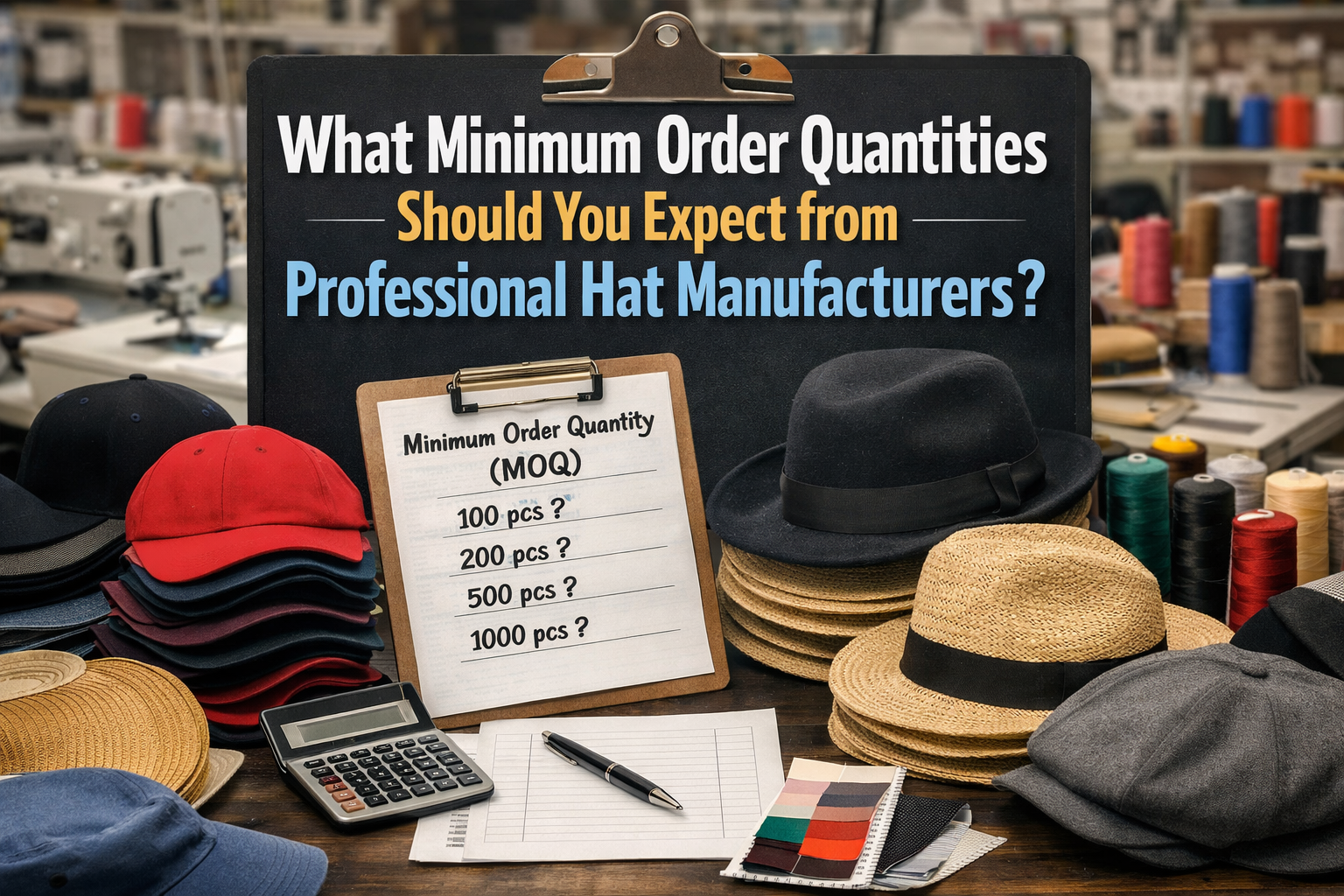
Big factories often ask for big orders—but small brands need to start small to test and grow safely.
Most professional hat manufacturers require MOQs between 100 and 500 pieces per style, depending on customization, location, and production type. Low-MOQ options (like 200 pcs) are ideal for startups.
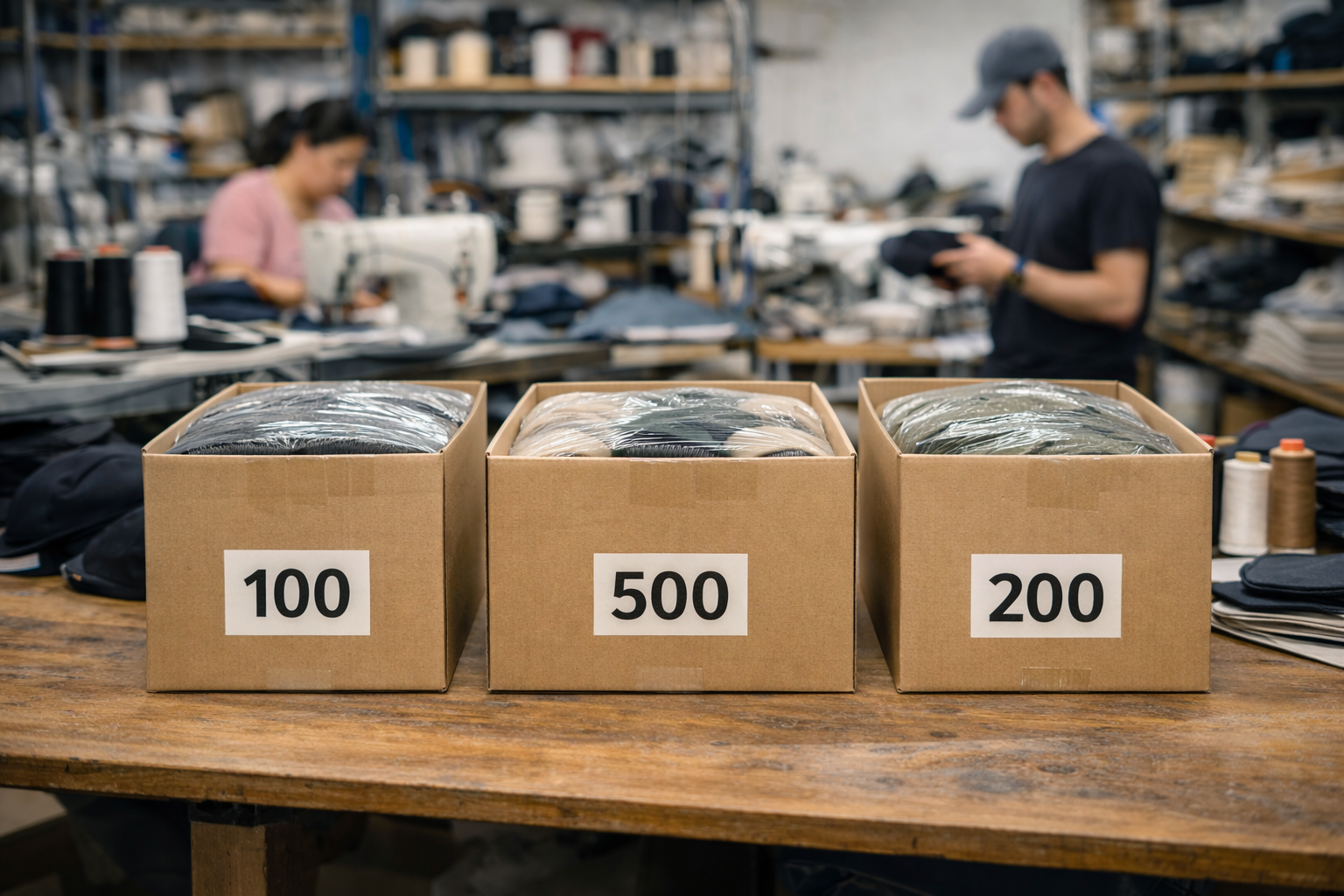
I’ve learned to ask about minimums early—before wasting time designing something I can’t afford to produce.
What Are the Typical Industry Standards for MOQ?
Every factory has a floor. You need to know what’s reasonable before negotiating.
China-based factories1 usually require 300–500 pcs per design, while U.S. decorators2 can offer MOQs as low as 25–50 for embroidered hats.
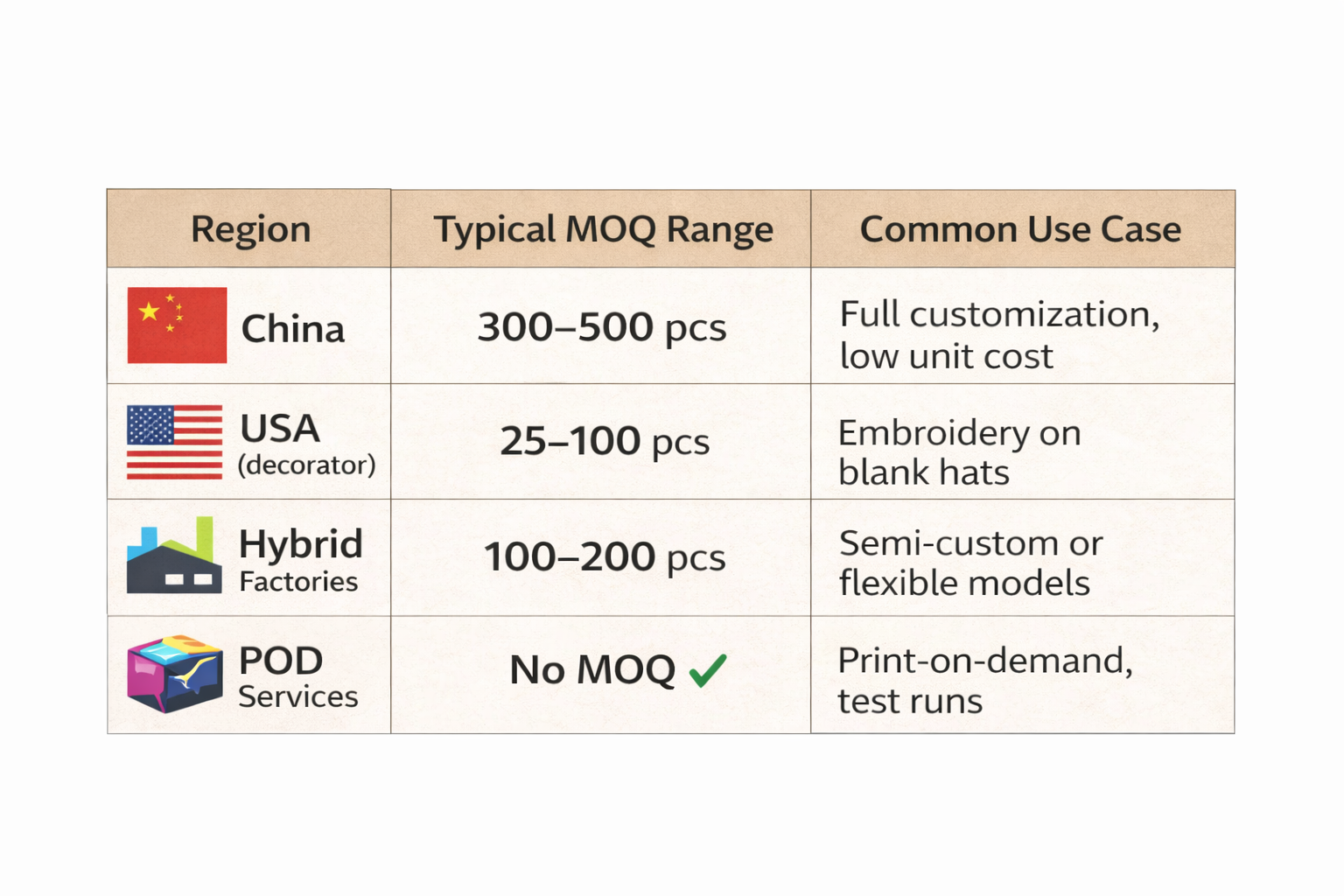
How MOQ Standards Differ by Market
When I started sourcing hats, I thought every factory would do small batches. I was wrong. Some wouldn’t touch an order under 1,000 pieces. Others offered small runs but didn’t allow any customization. I had to learn which options made sense for different stages of my business.
Here’s what I found:
| Region | Typical MOQ Range | Common Use Case |
|---|---|---|
| China | 300–500 pcs | Full customization, low unit cost |
| USA (decorator) | 25–100 pcs | Embroidery on blank hats |
| Hybrid Factories | 100–200 pcs | Semi-custom or flexible models |
| POD Services | No MOQ | Print-on-demand, test runs |
Low MOQ often means higher per-unit cost. But for small brands, it’s worth it to avoid excess stock. I started with 200 pcs per design through Anthea. It gave me real control without overcommitting.
What Factors Affect a Hat Manufacturer’s Minimums?
Not all minimums are about volume. Style, materials, and decoration complexity all matter.
MOQ depends on hat type, customization method3, fabric sourcing4, and whether the factory stocks raw materials or produces made-to-order.
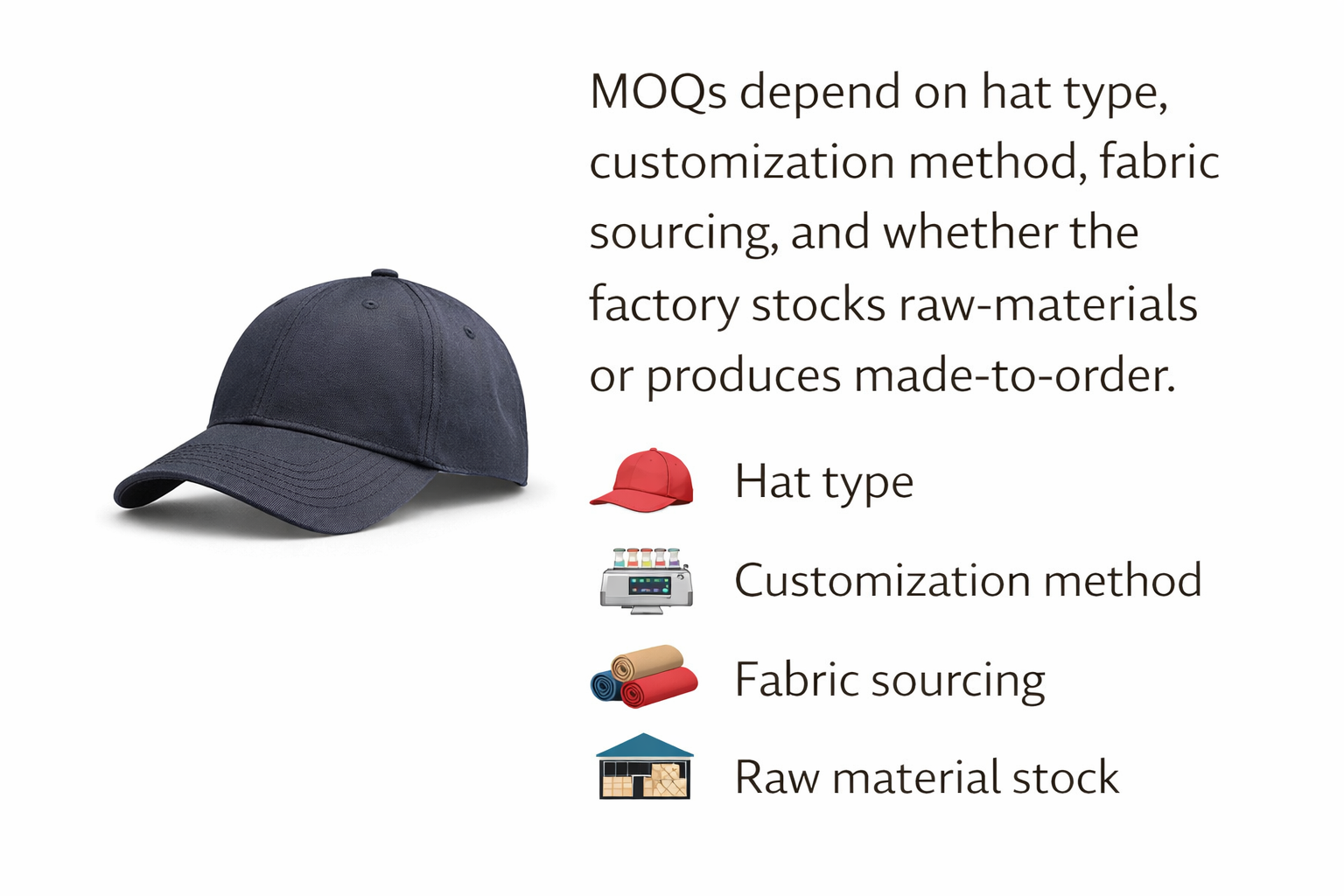
Why One Hat Might Require 500 and Another Only 100
I once asked for 100 wool bucket hats with custom piping and full-color embroidery. The quote came back with an MOQ of 500. I asked why. The factory said they didn’t stock wool, and they needed to hit a fabric supplier’s own MOQ. That’s when I realized how much behind-the-scenes sourcing affects MOQ.
Here’s what usually increases MOQ:
- Custom-dyed fabric
- New mold or pattern creation
- Specialty trims (rope, patches, metal buckles)
- Embroidery with more than 5 colors
- Fully custom shapes
And here’s what helps lower MOQ:
- Using factory’s in-stock materials
- Choosing a standard base style
- Limiting decoration to 1–2 placements
- Repeating colors across styles
| Factor | Impact on MOQ |
|---|---|
| Custom Fabric | Increases MOQ (200–500 pcs) |
| Factory Stock Materials | Decreases MOQ (100–200 pcs) |
| Complex Decoration | Increases MOQ |
| Digital Embroidery Only | Keeps MOQ Low |
Knowing what affects MOQ helps me design smarter.
Can You Negotiate Lower MOQs with a Factory?
Sometimes yes—but only if you offer something valuable in return.
Factories may accept lower MOQs if you offer repeat business potential, flexible delivery dates, or pay slightly more per unit.
How I Got a Factory to Accept 150 Units
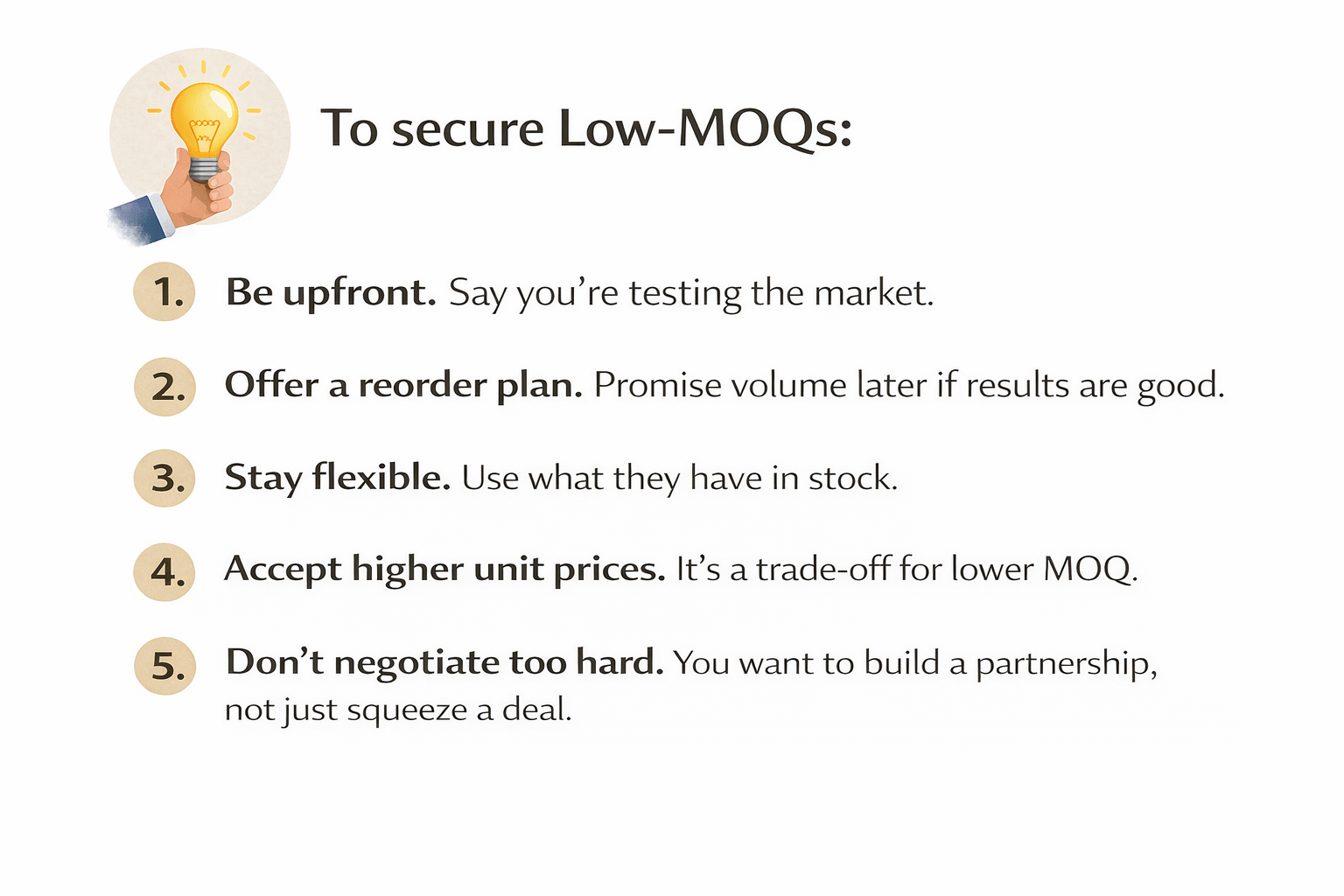
For one of my early projects, I needed only 150 hats. The factory’s listed MOQ was 300. I didn’t argue—I explained my situation. I shared my sales forecast, mentioned I planned to reorder monthly, and offered to use their stock fabric. They agreed. I paid a slightly higher unit cost, but it worked.
Here’s how I approach it:
- Be upfront. Say you’re testing the market.
- Offer a reorder plan. Promise volume later if results are good.
- Stay flexible. Use what they have in stock.
- Accept higher unit prices. It’s a trade-off for lower MOQ.
- Don’t negotiate too hard. You want to build a partnership, not just squeeze a deal.
| Tip | Why It Works |
|---|---|
| Ask for sample-level run | Some factories will treat it like a sample project |
| Offer brand story & vision | Helps them trust your potential |
| Be flexible on style/fabric | Keeps their production efficient |
| Offer testimonial or photo | They may value the marketing in return |
Factories are more open to small runs if you communicate well.
What Are the Best Options for Small Batch Hat Production?
If you’re testing a market or launching a first drop, small batch production5 is key.
Look for hybrid manufacturers6 like Anthea that offer low MOQs (around 200 pcs) without compromising quality or custom options.
How I Use Small Batch Orders to Grow Safely
When I started my brand, the thought of ordering 500+ hats was terrifying. What if no one bought them? I needed a partner who’d let me test without breaking the bank.
That’s when I found Anthea. They let me order 200 pcs per design, fully custom. I got:
- Embroidery
- Interior branding labels
- Retail-ready packaging
- Sampling in 7–10 days
This small batch gave me confidence. I sold out my first run, and had enough data to reorder with minor tweaks. I didn’t waste inventory. I didn’t tie up cash.
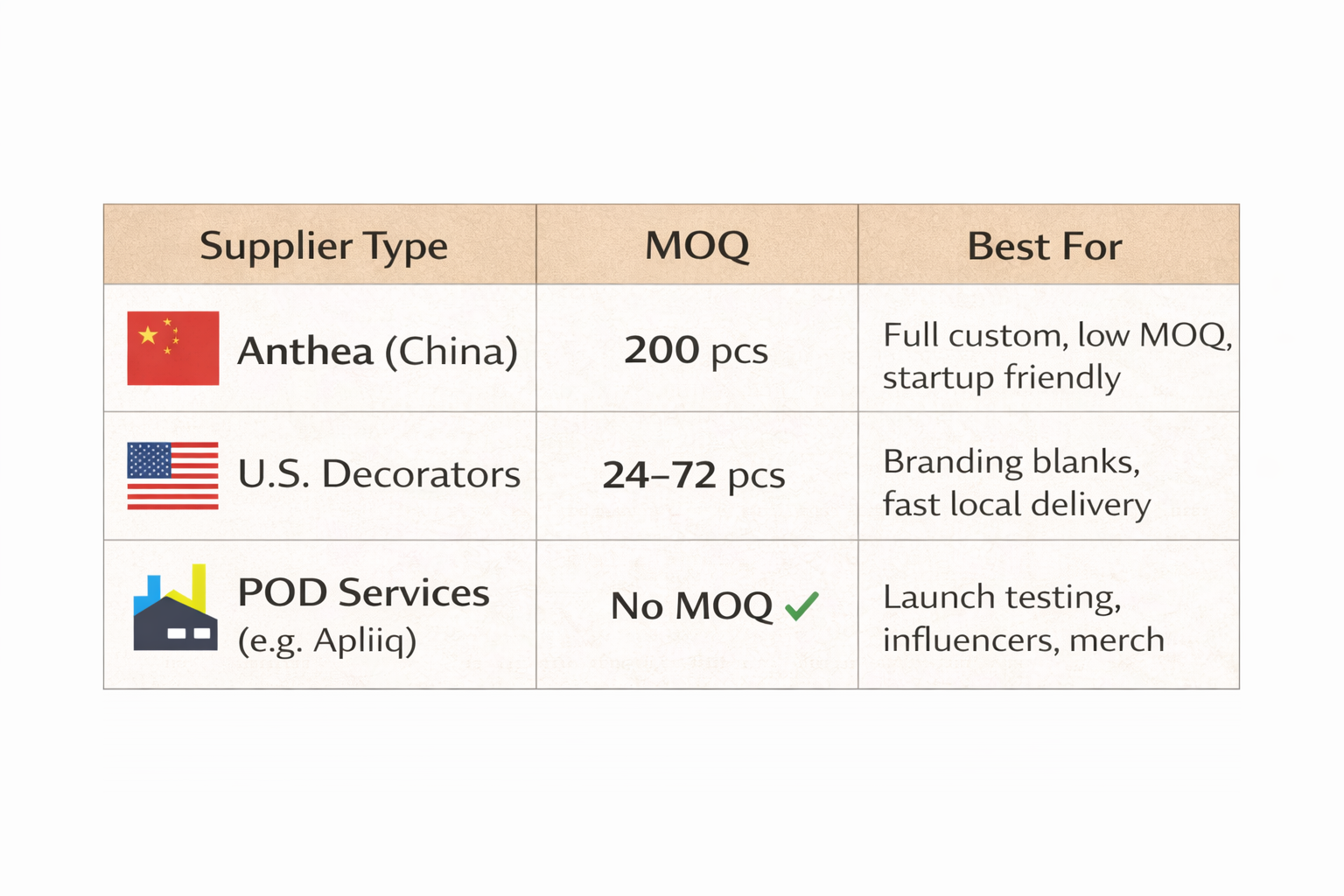
Here are three solid small-batch options I’ve used or tested:
| Supplier Type | MOQ | Best For |
|---|---|---|
| Anthea (China) | 200 pcs | Full custom, low MOQ, startup friendly |
| U.S. Decorators | 24–72 pcs | Branding blanks, fast local delivery |
| POD Services (e.g. Apliiq) | No MOQ | Launch testing, influencers, merch |
A small run lets you learn fast. And that helps you grow smart.
Conclusion
Knowing the right MOQ range helps you avoid over-ordering and choose partners who can grow with you.
-
Learn about the MOQ standards in China to better negotiate with manufacturers. ↩
-
Discover how U.S. decorators can offer lower MOQs, ideal for small businesses. ↩
-
Understanding how customization impacts MOQ can help in planning production effectively. ↩
-
Explore how sourcing materials can affect production costs and minimum order quantities. ↩
-
Small batch production allows for testing markets without large financial commitments. ↩
-
Find out how hybrid manufacturers can offer flexibility and lower MOQs for startups. ↩