Setting the right price for fashion accessories is tough. If the price is too high, you lose sales. If it is too low, you lose profit. I will explain how to balance this perfectly.
To price competitively, you must calculate total landed costs, including production and shipping. Then, apply a 4x to 6x markup based on your brand value. Working directly with a factory like Anthea helps you lower base costs. This allows you to keep high margins while offering fair prices to customers.

Many brand owners guess their prices. This is dangerous for business. It can lead to losing money on every sale. I want to share the exact math and strategies I use with my clients. These tips will help you build a profitable brand that lasts a long time.
What Is the Typical Cost to Manufacture Women’s Trucker Hats?
You might worry that custom hats are too expensive to make. This fear keeps many people from starting their own brand. But the real costs are often lower than you think.
The typical manufacturing cost for a custom women’s trucker hat ranges from $3 to $6 per unit. This price depends heavily on materials, logo complexity, and quantity. Basic foam truckers are cheaper, while hats with custom fabrics, detailed embroidery, or leather patches cost more.
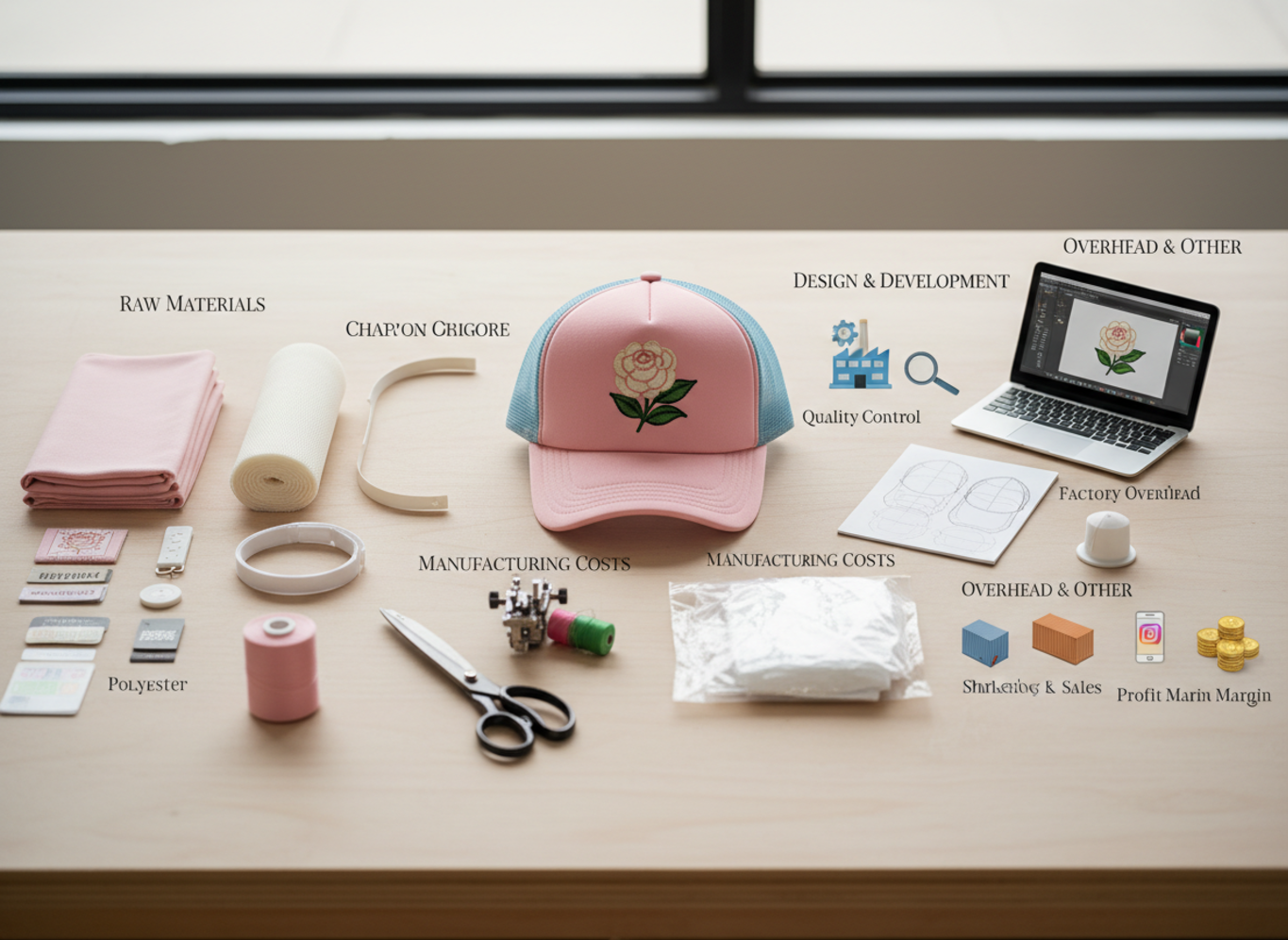
I see many clients struggle to understand the quote sheet. It helps to break the hat down into parts to see where your money goes. The biggest cost is usually the fabric. Standard polyester foam is very affordable and is the classic choice for trucker hats. If you want organic cotton, satin, or corduroy, the price goes up.
Next is the logo decoration. A flat screen print is the cheapest option. It is fast and uses less thread. A complex 3D embroidery takes more time on the machine, so it costs more money. Finally, you have internal labels and tags. These add value but also cost pennies. Here is a simple breakdown of how features affect the base price:
| Feature | Cost Impact | Why? |
|---|---|---|
| Standard Foam | Low | Easy to source and sew. |
| Suede/Velvet | High | Premium material cost. |
| Screen Print | Low | Fast production speed. |
| 3D Embroidery | Medium/High | Slow machine time. |
| Custom Tape | Low | Adds pennies per unit. |
Understanding these parts helps you control the final factory price. You can choose a cheaper fabric but a better logo to balance the cost. This allows you to create a hat that looks expensive but is cheap to make.
What Are the Key Pricing Differences Between Small and Large MOQs?
Ordering a huge number of hats is scary for new brands. But ordering too few makes the price per hat very high. You need to understand how quantity changes the cost.
Small orders, like 200 pieces, have a higher unit price because setup costs are split among fewer hats. Large orders, like 1000 pieces, spread these costs out. This lowers the price per hat significantly. Moving from 200 to 500 pieces often yields the best savings.
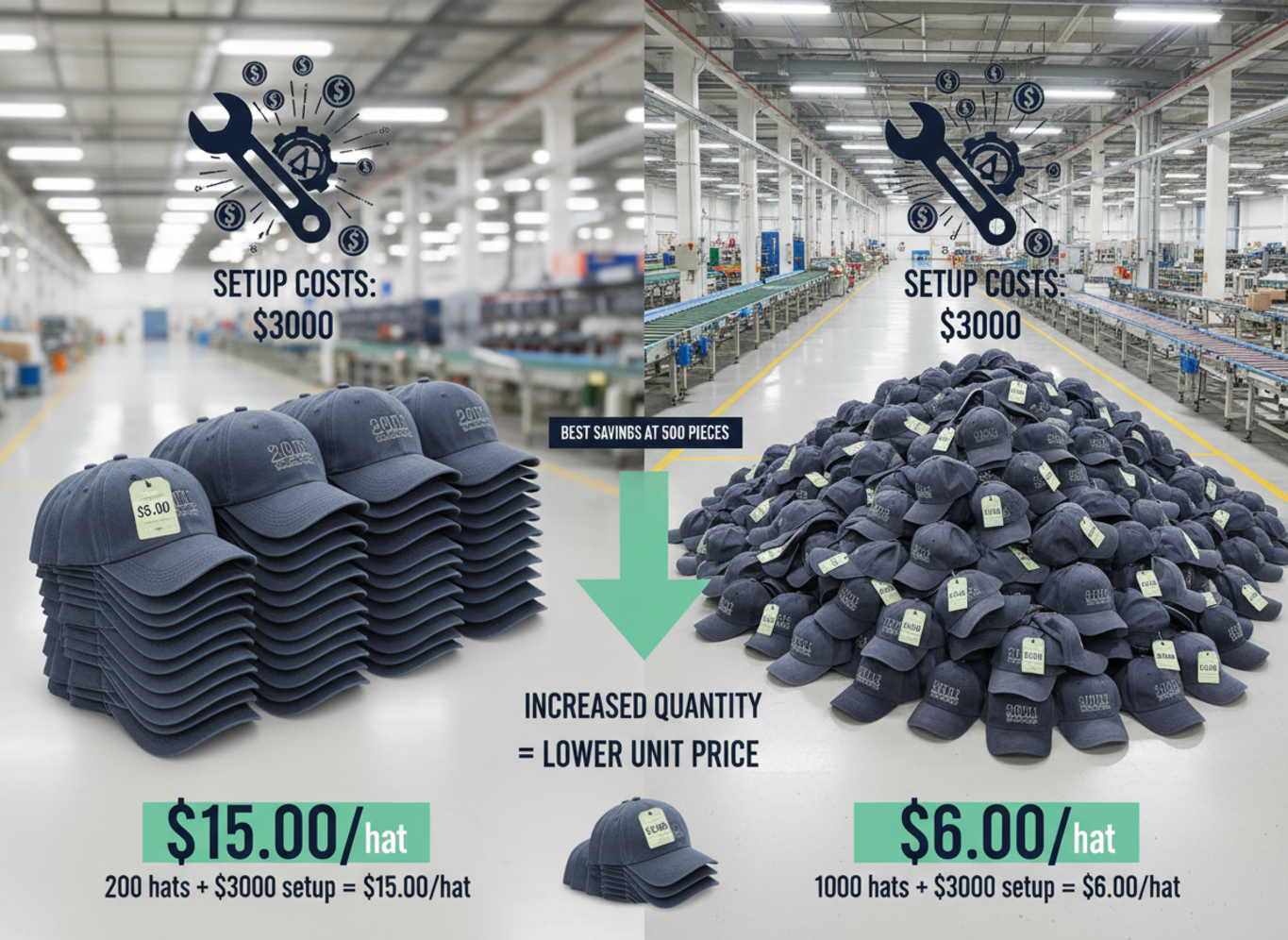
At Anthea, we support small brands with a 200-piece Minimum Order Quantity (MOQ). However, you must know that 200 hats cost more per unit than 2000 hats. Why is this? Every job has "setup costs." We have to set up the embroidery machines. We have to make the screens for printing. We have to cut the fabric. It takes the same time to set up the machine for 1 hat as it does for 1000 hats.
When you order 200 hats, you pay for that setup time across only 200 items. When you order 1000, that cost is shared by more items. The price drops fast. Also, when we buy fabric, we get better deals for big rolls. If you only need a little fabric, we pay a higher retail price for it.
- Small MOQ (200 pcs): Best for testing new designs. Higher unit cost, but lower risk of unsold stock.
- Medium MOQ (500-1000 pcs): The "sweet spot." Big price drop. Good for established sellers.
- Large MOQ (2000+ pcs): Lowest price. Best for wholesale distribution.
My advice is to start small to test the market. Once you know the design sells, increase your order size immediately. This creates more profit on the second batch.
What Profit Margins Are Realistic in Women’s Headwear?
You want to make money, but you do not want to look greedy. Many new owners ask me how much profit is normal. It is easy to miscalculate and lose cash.
A realistic profit margin for women’s headwear is between 60% and 80%. If your landed cost is $10, you should sell the hat for $30 to $50. This covers marketing, operations, and future growth. Fashion accessories allow for high markups because customers value style over raw material cost.
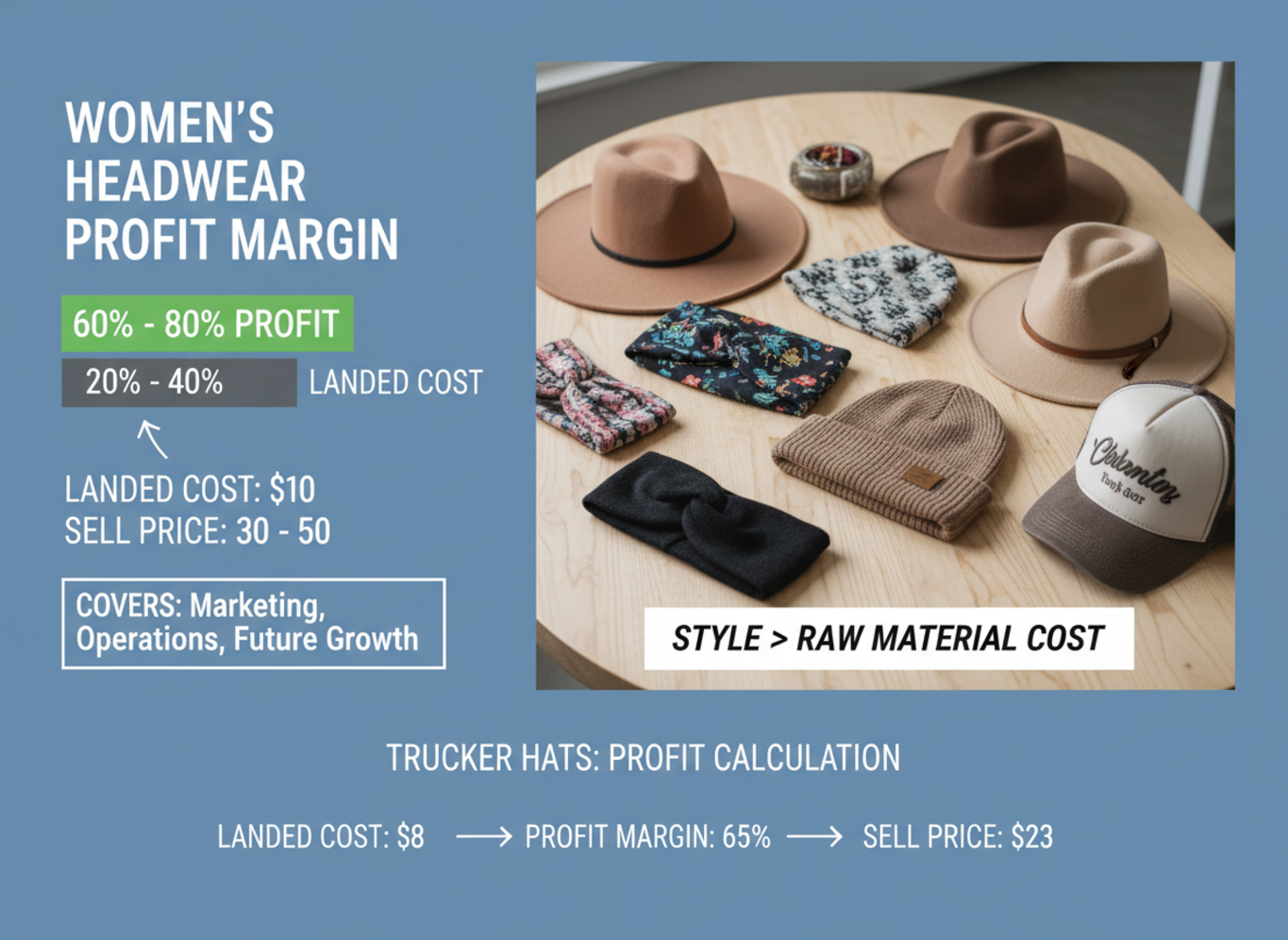
You need to aim for a 4x to 6x markup on your manufacturing cost. If the hat costs $5 to make and $3 to ship (total $8), you cannot sell it for $15. You will make zero profit after ads and taxes. You should sell it for $32 to $48. Women’s fashion is driven by emotion and trends. A customer does not care about the cost of the thread. She cares about how the hat makes her look.
Here is how the math works for different sales channels:
- Direct-to-Consumer (DTC): You sell on your website. You keep the full margin. You need high margins here to pay for Facebook or TikTok ads. Aim for 70-80% gross margin.
- Wholesale: You sell to a boutique shop. You sell at 50% off your retail price. If retail is $40, you sell to the shop for $20. Your cost is $8. You make $12 profit. The shop makes $20 profit.
- Events/Pop-ups: You have travel costs and booth fees. You need a price that covers these extra expenses.
Do not be afraid to price higher. If the design is unique and the quality is good, women are happy to pay for it. Low prices can sometimes make people think the quality is bad.
How Can You Offer Value Without Raising Base Costs?
You want your product to look premium, but you have a strict budget. Adding expensive materials can ruin your profit. There are smarter ways to make a hat look expensive.
You can increase perceived value by focusing on design details that cost very little. Custom inner taping, a woven tag on the sweatband, or a specific color match can make a hat feel premium. These features often cost pennies but allow you to charge a much higher retail price.
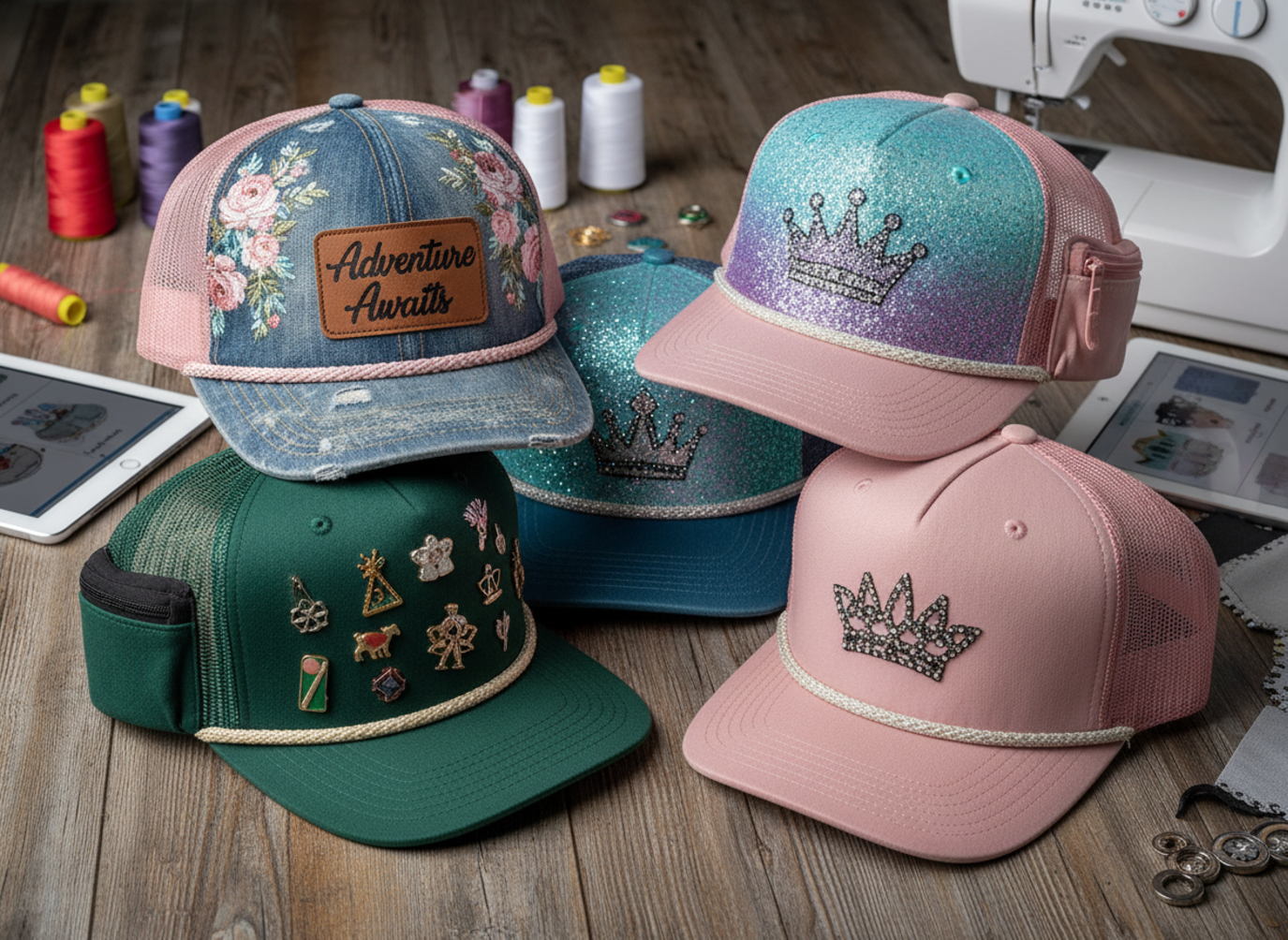
At Anthea, we have many tricks to make a $4 hat look like a $40 hat. It is all about the "unboxing" experience and the hidden details. Customers look at the inside of the hat to judge quality. If they see messy stitching, they think it is cheap. If they see clean custom taping with your logo, they think it is luxury.
Here are three cheap upgrades I recommend:
- Custom Inner Taping: This covers the seams inside the hat. It costs very little to print your brand name on it. It looks very professional and clean.
- Woven Labels: A small tag on the back snap or the sweatband adds branding. It makes the product feel like a real brand, not a generic item.
- Stickers: A shiny foil sticker on the brim suggests the hat is new and authentic.
- Hang Tags: A thick paper tag with your brand story adds emotion.
These items might add $0.30 to your total cost. But they allow you to raise the selling price by $5.00 or more. This is the smartest way to increase your margin without changing the main materials.
Should You Price Differently for Each Market Segment?
One price does not fit all customers. A college student has a different budget than a luxury shopper. Using a single price might limit who can buy your products.
Yes, you should price differently based on the target audience. A "Basic" line can attract volume sales, while a "Limited Edition" line can command higher prices. Creating tiers allows you to capture budget-conscious buyers while still serving those willing to pay for exclusivity.
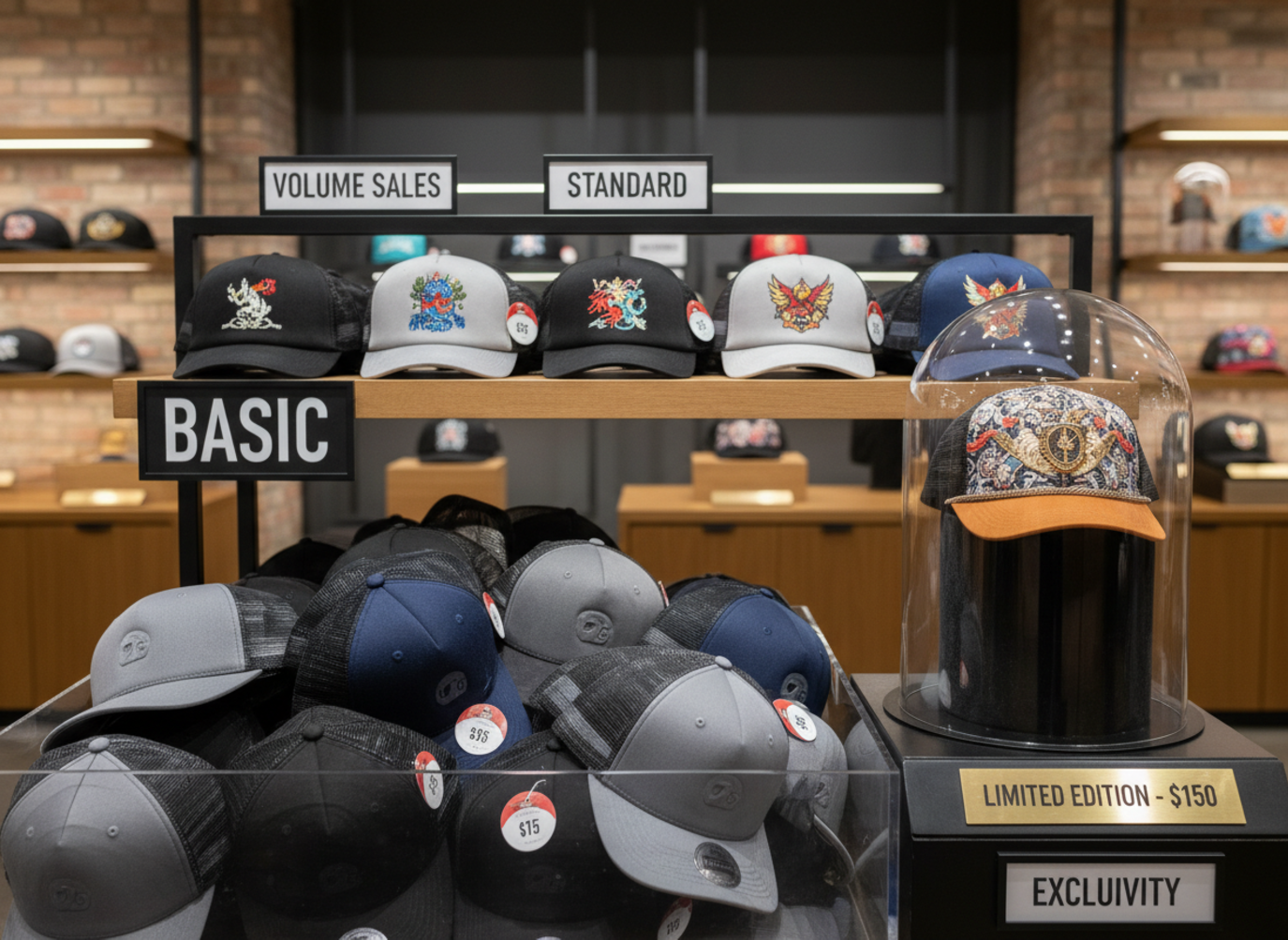
I often tell brand owners to think like a car company. They have a basic model and a luxury model. You can do the same with hats. You can use the same factory (Anthea) to make both lines. This helps you capture more of the market.
- The Entry Level: Use standard foam and a simple screen print. Price this at $25. This is for customers who just want your logo and a cool color. It brings people into your brand.
- The Mid-Range: Use cotton twill or corduroy. Use 3D embroidery. Price this at $35-$40. This is your main seller. It shows quality and durability.
- The Premium/Limited Tier: Use specialty fabrics like satin or distressed leather. Add a metal badge or complex patch. Make only 50 pieces. Price this at $60+. This creates "hype."
By having these tiers, you do not lose the customer who only has $25. But you also give the rich customer something special to buy. This strategy maximizes your total revenue and builds a stronger brand image.
What Legal and Business Costs Should Be Considered?
Many entrepreneurs forget about hidden business costs until it is too late. This leads to cash flow problems. You must account for taxes and fees before you set your price.
You must include tariffs, import duties, sales tax, and transaction fees in your pricing model. Shipping from China to your country also adds to the unit cost. If you ignore these, your calculated profit will disappear when the bills arrive.
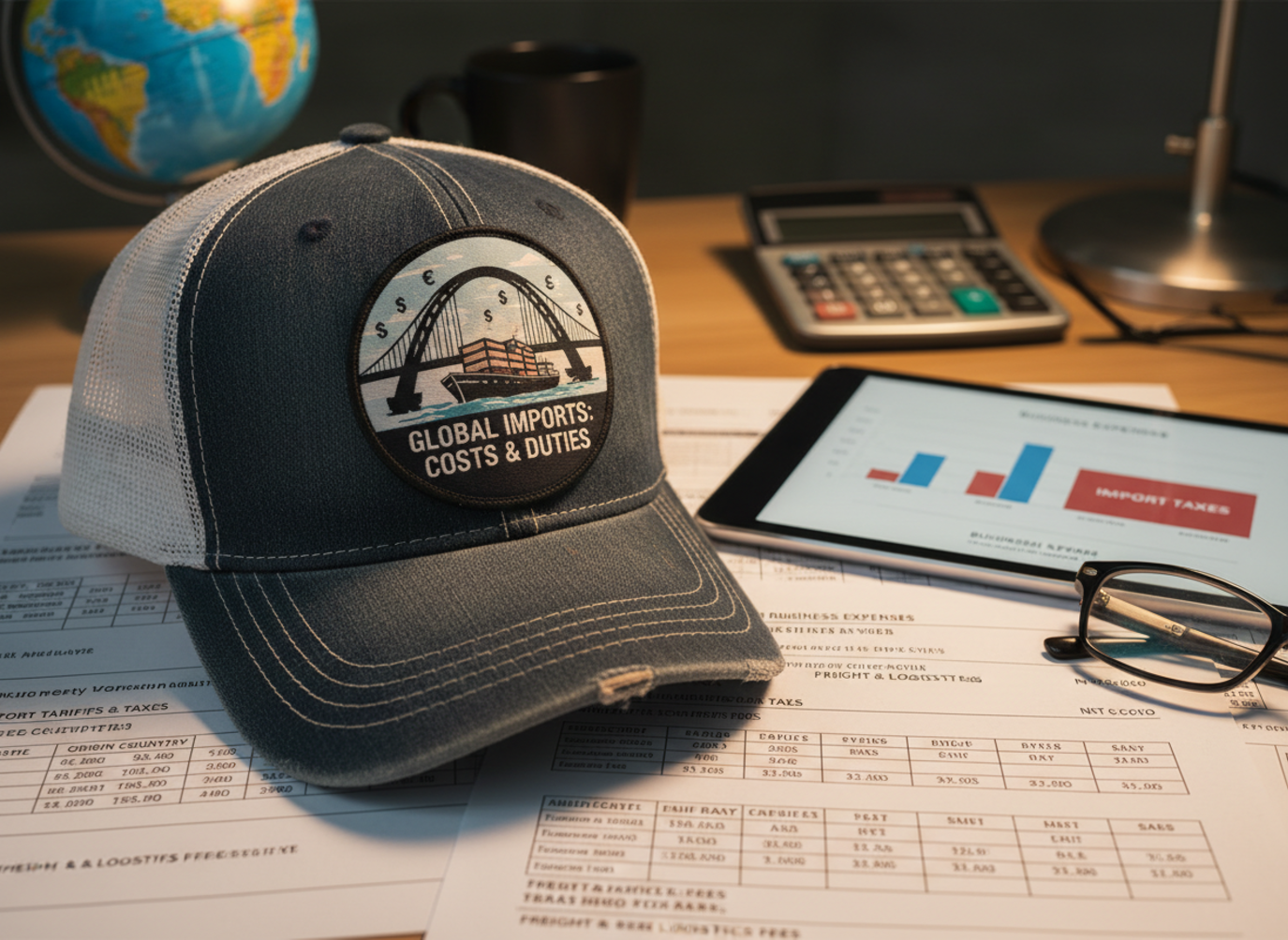
I have seen people calculate profit based only on the factory price. This is a mistake. When you import from China, the price on the invoice is not the final price. Let’s list the real costs you must pay.
- Shipping: Air freight is fast (7 days) but expensive. Sea freight is slow (30 days) but cheap. You need to decide which one fits your launch date. Air freight can add $2 per hat. Sea freight might be $0.50 per hat.
- Customs Duties: When goods enter the USA or Europe, the government charges a tax. For hats, this can be significant. You need to check the HS Code for headwear to know the rate.
- Transaction Fees: When you pay the factory via bank wire or PayPal, there is a fee. When a customer buys from you via Shopify, credit card processors take about 3%.
| Cost Type | Estimated Impact |
|---|---|
| Factory Price | 40% of total cost |
| Shipping | 20% of total cost |
| Duties/Taxes | 15% of total cost |
| Marketing | 25% of total cost |
You must add all these up to find your "Landed Cost." Only then can you set a safe retail price.
Where Can You Find Competitive Women’s Hat Manufacturing Near You?
You might look for a local factory to save time, but the prices are often too high. Finding a partner who offers both quality and low prices is difficult locally.
While local manufacturing offers speed, overseas manufacturers like Anthea often provide better pricing and customization options. We offer the best of both worlds: factory-direct pricing from China with the communication and reliability you expect from a local partner. We handle logistics to make importing easy.
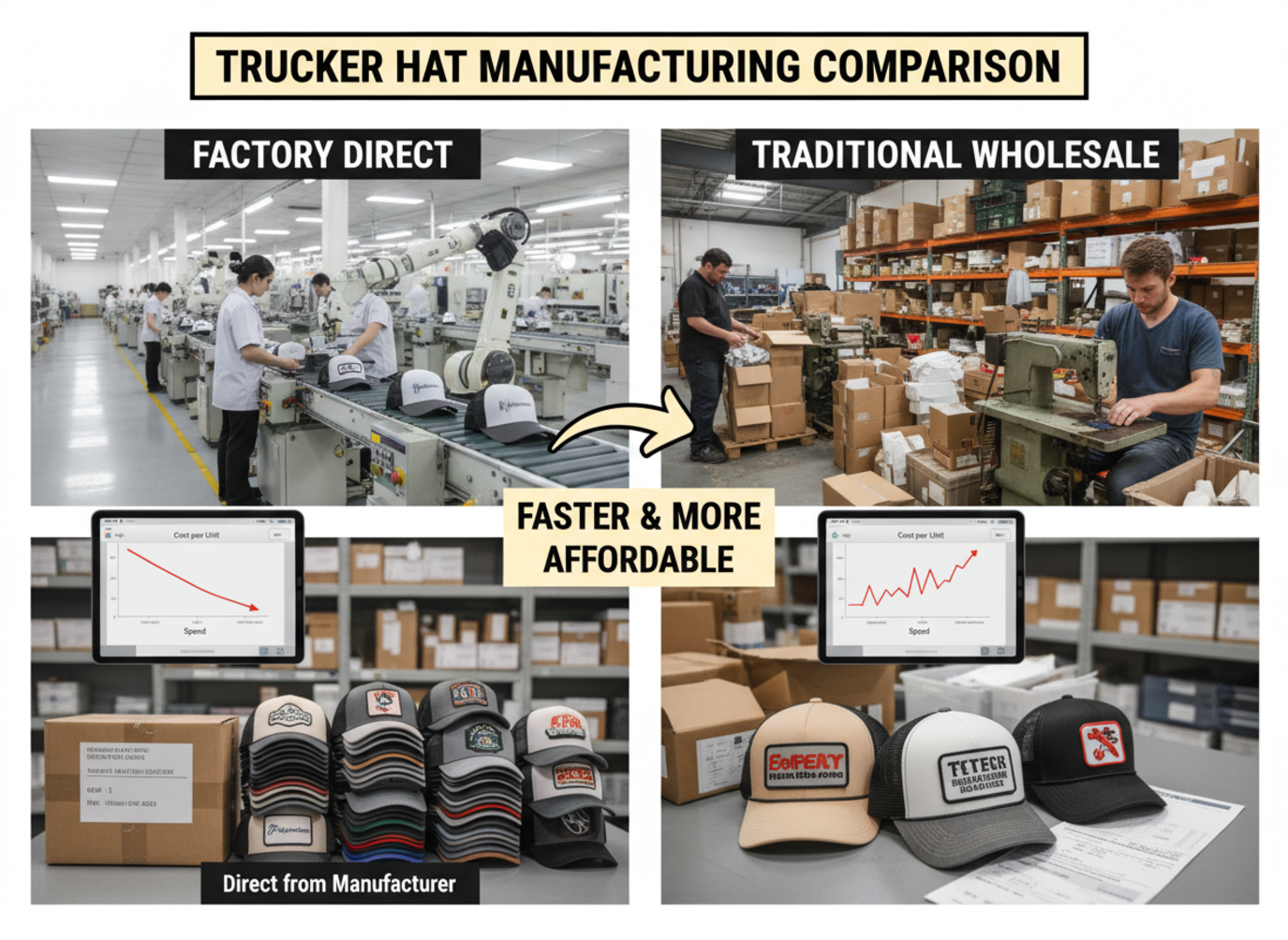
Many of my clients start by looking for factories in their own city. They quickly find that the cost is $15 or $20 per hat. This makes it impossible to sell for a profit unless you are a luxury brand. The labor cost in Western countries is just too high for headwear. This forces prices up.
This is why competitive brands look overseas. However, the fear is poor communication or bad quality. This is where my company, Anthea, fits in. We act as your production partner.
- We speak your language: You do not need to worry about translation errors or confusion.
- We handle the mess: We manage the shipping and customs paperwork.
- We are flexible: Most big factories want 1000 pieces. We start at 200.
- We are fast: We can make samples in 7 to 10 days.
You get the low cost of Chinese manufacturing (allowing for that 80% profit margin) but with the service level of a local company. This gives you a massive competitive advantage over brands that pay double for local production.
Conclusion
Pricing women’s hats requires knowing your total landed costs and understanding your customer’s value perception. By partnering with a factory like Anthea, you can keep costs low and margins high.