You approve a perfect sample, but the mass production arrives looking wrong and cheap. This nightmare wastes your hard-earned money and hurts your brand reputation. A strong quality agreement prevents this disaster completely.
A bulletproof quality agreement is a binding contract1 that defines acceptable defect rates2, specific material standards3, and inspection methods4. It aligns expectations between you and the manufacturer, ensuring the final product matches the approved sample perfectly and protecting your investment if errors occur.
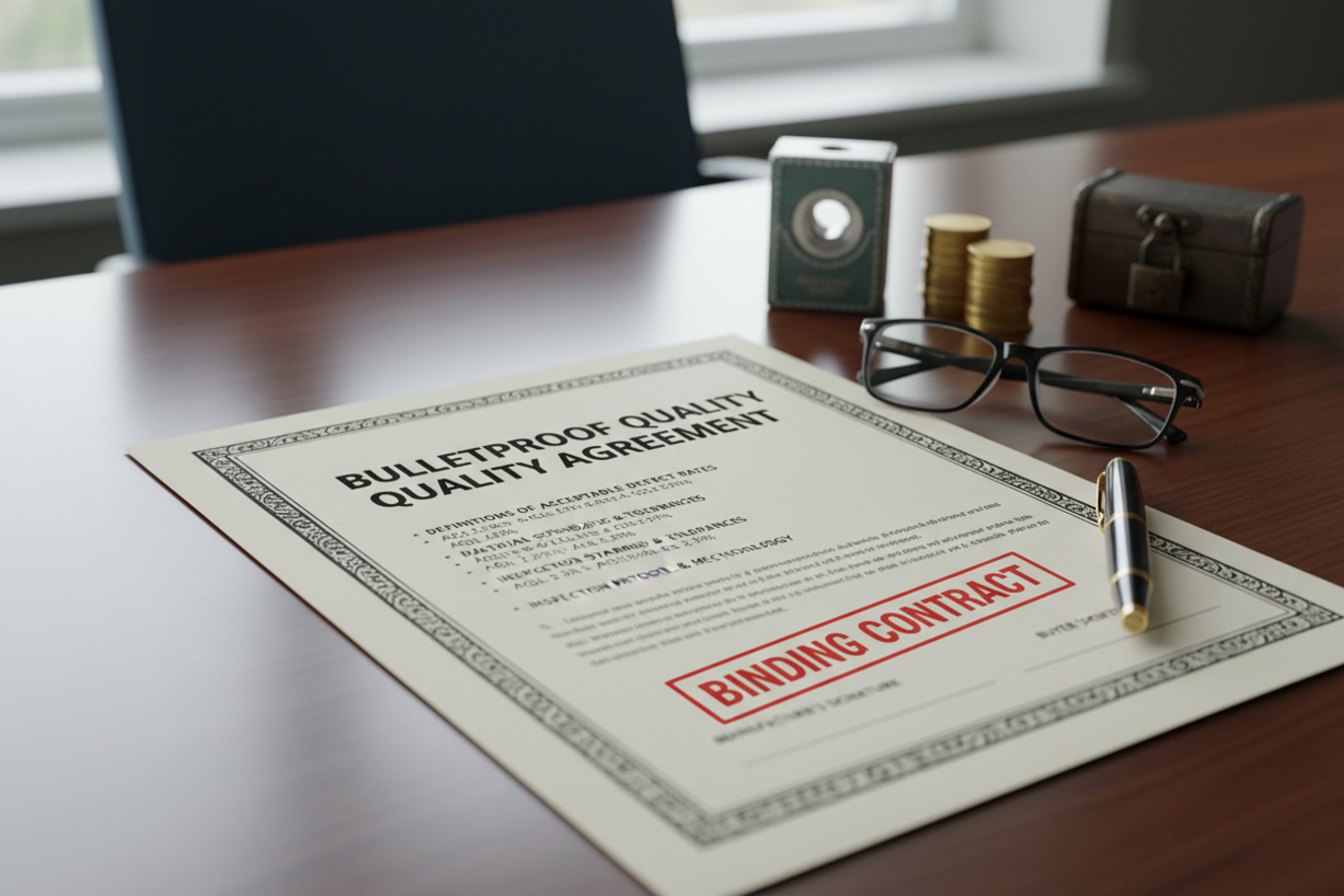
Many brand owners think a handshake or a simple invoice is enough to start production. However, without written rules, you are gambling with your inventory. I have seen too many creators lose money because they trusted a verbal promise instead of a written plan. Let us look at exactly what you need to include to keep your business safe.
What are the key components of a quality agreement in manufacturing?
You might feel overwhelmed by legal terms when starting a new order with a factory. Ignoring the details now leads to massive confusion and arguments later. You must know the basic building blocks first.
Key components include detailed product specifications5, defined Acceptable Quality Limits (AQL)6, inspection protocols7, and approved reference samples8. These elements create a clear standard that leaves no room for guessing, ensuring both the factory and the buyer understand exactly what constitutes a "good" product.

At Anthea, I see many new clients send a photo and simply say "make this." This is dangerous. A real agreement relies on data, not just pictures. To make your agreement strong, you must break down the physical product into a list of requirements that cannot be argued.
Product Specifications (The Tech Pack9)
The heart of your agreement is the "Tech Pack9." This is not just a design file; it is a rulebook. For a custom hat, this includes the exact fabric weight (e.g., 280gsm cotton twill10), the specific Pantone color code11 for the fabric, and the thread type for the embroidery. If you do not write down "Polyester thread12," the factory might use "Cotton thread" to save money. Your agreement must state that the Tech Pack9 is the final standard.
Acceptable Quality Limits (AQL)6
You cannot expect 100% perfection in mass manufacturing, but you can define what is "too bad." We use a system called AQL. This sets a limit on how many defects are allowed in a batch.
| Defect Type | Description | Standard AQL Limit |
|---|---|---|
| Critical | Dangerous issues (e.g., needle left in hat) | 0 (Not allowed) |
| Major | Product is unusable (e.g., wrong logo color) | 2.5 |
| Minor | Small issues (e.g., loose thread inside) | 4.0 |
By including this table in your agreement, you and the factory agree on the math. If the defects cross these numbers, the whole order fails. This removes feelings from the equation and relies on facts.
How can agreements prevent sample-to-production quality issues?
The "bait and switch" is a common fear for every fashion entrepreneur and brand owner. Receiving low-quality bulk items after a great sample feels like a betrayal. Your agreement stops this.
Agreements prevent these issues by legally binding the mass production quality to the signed "Golden Sample13." They force the factory to use the same material batches and production lines, ensuring consistency. If the final product deviates from the sample, the agreement triggers penalties.
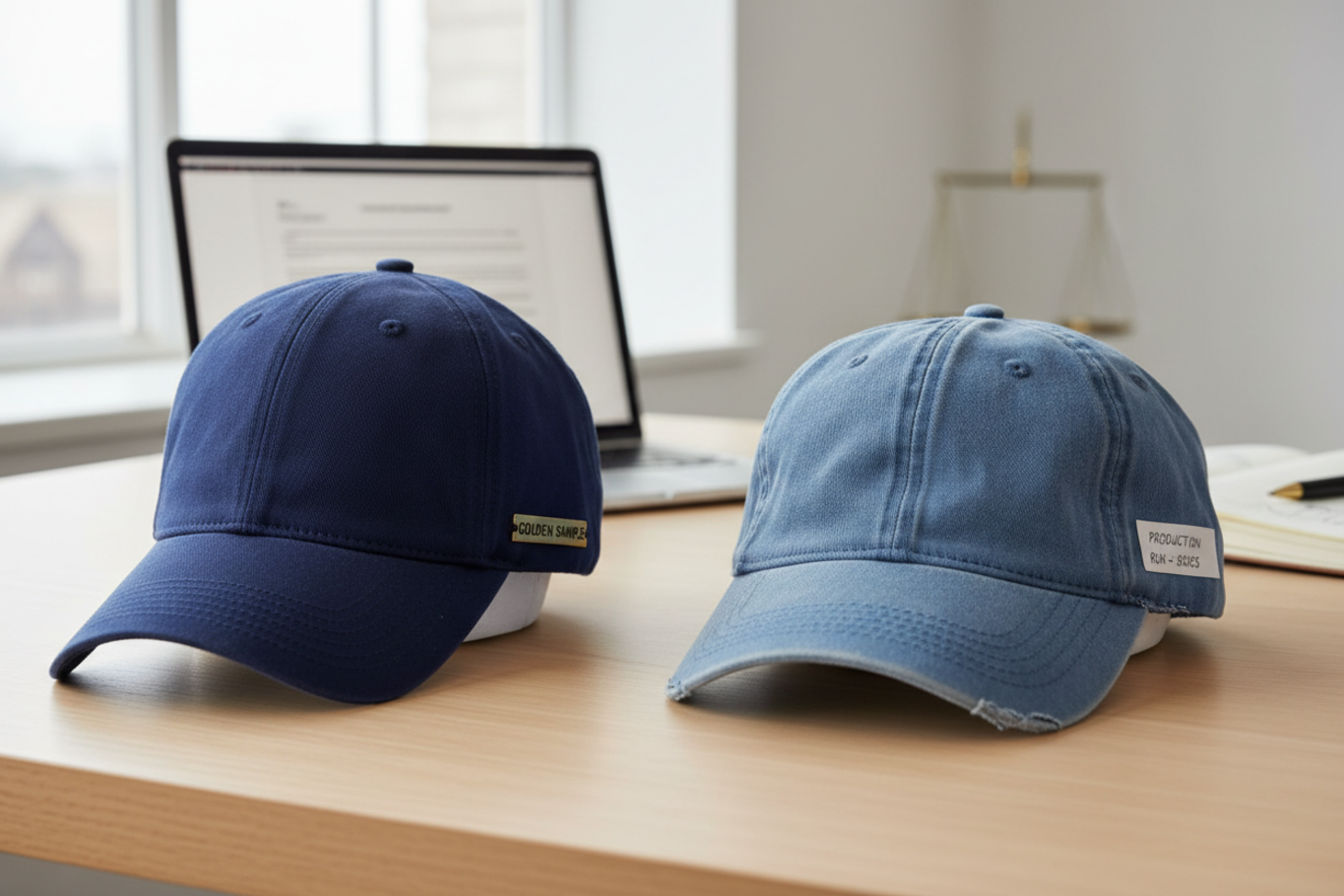
The biggest problem I see is when a factory uses premium materials for the sample to win your business, but switches to cheaper materials for the bulk order. This is why your agreement must focus heavily on the "Golden Sample13."
The Golden Sample13 Rule
Before mass production starts, I always ask my clients to approve a final sample. We make two copies. You keep one, and we keep one. You must sign and date the sample we keep at the factory. Your agreement should say: "Mass production must match the signed Golden Sample13 in hand-feel, color, and shape." This physical object becomes part of the contract. If the bulk hats feel thinner than the sample, you have the proof in your hands.
Material Locking14
Your agreement needs a clause that forbids material substitution. Sometimes a factory runs out of the specific fabric you chose. Without an agreement, they might buy a "similar" fabric from a market to finish the job quickly. Your contract must state: "No material changes are allowed without written approval.15" This forces the factory to ask you first.
Production Line Consistency
Sometimes the sample is made by a master sewer, but the bulk order is made by interns. While you cannot control who sits at the machine, your agreement can demand that the production method remains the same. For example, if the sample logo was 3D embroidery, the agreement ensures they do not switch to flat embroidery to save time.
Why is documentation critical in manufacturing quality agreements?
Verbal promises are easy to make and even easier to forget when problems arise. Relying on WhatsApp chats for quality standards is a recipe for disaster. You need hard evidence.
Documentation is critical because it serves as the single source of truth16 during disputes. It transforms subjective opinions into objective facts. Detailed records of material tests, color approvals, and inspection reports provide the proof needed to hold manufacturers accountable if standards are not met.

In the heat of production, it is easy to say "looks good" on a video call. But memory fades. Documentation is the only thing that stands up in a dispute. At Anthea, we encourage clients to keep a digital paper trail for every decision.
The Bill of Materials (BOM)17
This is a document you should attach to your agreement. It lists every single item used to make your product. For a snapback, this includes the plastic buckle, the sweatband, the inner taping, and the top button. If the factory uses a cheap plastic buckle that breaks, you can point to the BOM where it lists "High-density PVC buckle." If you do not document the specific parts, the factory has not technically broken any rules by using a cheaper part.
Third-Party Inspection Reports
Your agreement should give you the right to send a third-party inspector (like SGS or Intertek)18 to the factory before the goods ship. The report they generate is a crucial document. If the report says "Failed," your agreement uses this document to trigger repairs. Without this written right to inspect, a factory could refuse to let an inspector in.
Color Approval Sheets (Lab Dips)19
Before dyeing fabric, we send "Lab Dips" (small fabric swatches) for you to pick the color. Once you pick one, that approval email is a binding document. If the final hats are too dark, you can show the agreement and the approved Lab Dip. It proves the factory made a mistake.
Change Log20s
If you change your mind halfway through—say, you want to change the logo size—this must be documented in a "Change Log20" and signed by both parties. Never just send a text message. A formal change request form prevents the factory from saying, "Oh, I didn’t see that message."
What remedies should be included for quality deviations?
Finding defects is stressful, but not knowing what to do next is worse. You do not want to argue about refunds while sitting on bad stock. You need a plan.
Your agreement must include clear remedies such as 100% repair at the factory’s expense, replacement of defective goods, or monetary refunds. It should also define who pays for return shipping and third-party re-inspections to ensure you are not financially liable for the factory’s mistakes.

I always tell brand owners: hope for the best, but sign for the worst. If you do not define the punishment for bad quality, the factory has no motivation to fix it. A strong agreement lists the consequences clearly so everyone knows the stakes.
The "Repair or Replace" Clause
This is the most standard remedy. If the defect rate is higher than the AQL limit we discussed earlier, the factory must fix it. Your agreement should say: "Manufacturer must rework all defective items within 15 days at their own cost." This protects your launch timeline. If the items cannot be fixed (like fabric cut too short), the clause must demand a full replacement.
Financial Responsibility for Shipping
This is where many new businesses lose money. If you receive bad goods in the USA, shipping them back to China for repair is very expensive. Your agreement must state: "If the error is the manufacturer’s fault, the manufacturer pays for return shipping." Even better, the agreement should allow you to destroy the bad goods locally (with video proof) and receive a refund, so you do not have to deal with shipping at all.
Re-Inspection Fees
If the first inspection fails, you have to send the inspector back a second time. Who pays for that? It should not be you. Your agreement needs a line that says: "If a shipment fails inspection, the manufacturer pays for all subsequent re-inspections." This stops the factory from trying to ship goods they know are bad, hoping you won’t notice.
Discount Options
Sometimes the defect is minor—maybe the red color is 5% lighter than expected. You might still want to sell the hats but at a discount. Your agreement can include a "Discount Clause." This states that if you accept slightly off-standard goods, the factory must give a 20% or 30% discount on the invoice. This helps you recover the profit margin you lose by selling the items as "seconds."
Conclusion
A strong quality agreement is not just paperwork; it is your safety net. It ensures your brand delivers excellence, protects your budget, and builds a trusting, long-term relationship with your supplier.
-
Helps you understand enforceability so your agreement has real legal weight if quality disputes happen. ↩
-
Shows realistic targets and lets you set defect thresholds that protect your inventory and margins. ↩
-
Gives examples and wording to prevent material downgrades that make products feel cheap. ↩
-
Helps you choose the right inspection approach to catch issues before shipment and avoid rework. ↩
-
Provides structure and checklists so factories can’t “guess” details and produce inconsistent goods. ↩
-
Explains sampling math and pass/fail rules so you can enforce objective acceptance criteria. ↩ ↩
-
Clarifies steps and documentation so inspections are consistent, repeatable, and defensible. ↩
-
Teaches how to control the “reference truth” so bulk production matches what you approved. ↩
-
Offers a proven contents list so your factory gets exact instructions, not vague design intent. ↩ ↩ ↩
-
Helps you pick fabric weights that match the sample feel and avoid thin, low-quality substitutes. ↩
-
Explains color communication so you reduce shade errors and avoid costly color disputes. ↩
-
Shows durability and performance differences to prevent thread swaps that reduce quality. ↩
-
Explains how to make the sample contractually binding so you can enforce consistency. ↩ ↩ ↩ ↩
-
Provides clause ideas to stop “similar material” swaps that quietly downgrade the product. ↩
-
Teaches practical enforcement steps so changes can’t happen without your explicit sign-off. ↩
-
Helps you centralize decisions and reduce disputes caused by scattered messages and files. ↩
-
Shows how to lock every component so suppliers can’t swap parts without breaching terms. ↩
-
Helps you understand independent inspections and how reports support refunds or rework. ↩
-
Explains the approval workflow so you can prove the agreed color if bulk dye is wrong. ↩
-
Provides a template mindset so changes are traceable, signed, and not lost in chat threads. ↩ ↩